The television series Friends was an iconic show that, oddly enough, touched on some interesting law-related issues. In seasons 5 there was an episode where Phoebe and her police-officer boyfriend were rudely awakened by a squawking bird. Phoebe’s boyfriend nonchalantly pulled out his gun and shot the bird, much to her dismay. 
We know many people that have considered treating pesky magpies in this manner: especially in the spring, when they so loudly protect their nests, and feed their young with the babies of other birds. But what would happen if one were to do this in Alberta? Would it be a violation of any bylaws? Or criminal laws even?
What birds are protected?
The starting point for figuring out if you can shoot a bird is to look to see if there are any laws protecting birds.
In Alberta, the federal Migratory Birds Convention Act and the Migratory Birds Hunting Regulations combine to protect the majority of birds. The Alberta Guide to Hunting Regulations further explains which birds a hunter needs a license to shoot. A non-exhaustive list of exceptions to this licence rule includes birds like magpies, pigeons, and crows.
But even if you shoot one of these exempt birds you have to be mindful because you might be caught violating one of many firearm laws.
What levels of government govern firearm laws?
The federal government, provincial governments and individual municipalities all have laws governing firearm use. The federal government regulates firearms through the Firearms Act and Part III of the Criminal Code of Canada. These laws work together to ensure that firearms are properly registered and used safely.
The provinces have the power to make laws governing hunting, and they have often used this power to govern firearm use. In Alberta, firearm use in the province is regulated by the Alberta Wildlife Act. This Act covers multiple issues including the prohibited use by minors unless under the supervision by a guardian or someone similar (section 31(1)).
At the municipal level many cities have crafted bylaws controlling firearms within their limits. For example, section 9 of Edmonton’s Public Places Bylaw outlaws the possession and firing of any weapon capable of shooting a projectile in public places, and in Strathcona County there is a bylaw that prohibits the use of firearms within the urban area.
So can I shoot that annoying magpie?
Whether or not you can shoot that annoying bird will largely depend on where you live.
Under certain circumstances you can discharge a properly registered firearm on your property if you live on a farm where there aren’t any bylaw or safety issues.
This becomes less likely if you live in a densely populated area. For example, section 86(1) of the Criminal Code prohibits careless use of a firearm and section 52(1) of the Alberta Wildlife Act prohibits discharging a firearm within 200 yards of an occupied building under most circumstances. Finally, your city or town might also have bylaws that regulate the use of firearms. Some even apply when on private land like in Strathcona County.
Other solutions
Just because you can’t simply shoot that annoying bird carte blanche, that doesn’t mean that there are not some viable solutions. Across the province, there are many cities that employ animal control officers to assist in dealing with pests like birds. For example, in Edmonton there is the Animal Care and Control Centre. They can help you legally trap pest animals such as skunks, porcupines, squirrels, ground squirrels, magpies, and crows on your own property.
Crows and magpies can be particularly annoying. Alberta Fish and Wildlife explains that they will eat anything and it is important to keep garbage secure or they may venture on your property. You can also trim your trees until the cover they provide is too thin to provide protection for larger birds or use frightening devices like scarecrows or hawk kites.
So you may want to think twice before shooting that annoying bird because you may end up doing more than just ruffling a few feathers.
This is a guest post by Cameron Mitchell, a third year law student who is volunteering with the Centre for Public Legal Education Alberta.
The Neighbour Series Part 3: Pets and bylaws
Whether you’re a cat person, a dog person, or even a snake person, there are probably bylaws that apply to you. Cities across the country have turned to bylaws to regulate pet ownership, and in this latest edition of our Neighbour Series we will be exploring some of the intricacies of this area.
Licensing and regulations
Pet bylaws often cover two important areas: licensing and what you have to do before you get a pet, and also the rules and regulations you have to follow once you get your pet. This is quite important, as if a neighbour phones to complain about your pet’s behavior, the ensuing problems will magnified if you have not followed the rules for ownership of that pet.
Calgary and Edmonton both have licencing requirements for dogs and cats, as do many other communities, and they might not all be the same! The Edmonton bylaw, for example, requires that all dogs and cats over six months get a licence, and it prohibits the granting of a licence to a person under the age of 18. These are annual licences that require the payment of a pet-licencing fee. Even pigeons need a licence!
The second, and equally important, part of the bylaw lists off the rules that responsible dog and cat owners must follow. A few examples:
- dog owners must ensure that the dog does not bark in a manner that is likely to disturb or annoy others;
- owners must also remove any of their dog’s poop that is left on public or private property;
- with regard to cats, the owner must make sure that the cat doesn’t enter the private property;
- both dogs and cats must display the licence tag issued by the city at all times when they are off the owners’ property; and
- there is multi-step process, often with very serious consequences, if your pet bites another person.
It is also worth noting that these bylaws can apply beyond the owner to cover dog walkers, friends, family, and anyone else who has care and control of the pet.
Edmonton’s Animal Care and Control department enforces these bylaws. They also investigate all pet related complaints including cats or dogs found at large. You can call 780-442-5311 or email 311@edmonton.ca if you wish to make a complaint.
Exotic pets and prohibited animals
Often, cities will also have bylaws in place to control exotic pets. You may remember the heartbreaking story of Connor and Noah Barthe from New Brunswick who were killed by an African rock python this past summer. Even though New Brunswick does have laws prohibiting these types of snakes (unless through an accredited zoo), it could not prevent this tragedy. Alberta also has laws covering these types of exotic pets and the only way that you can get one is if you get a permit from the provincial ministry that administers the Wildlife Act (which is currently Environment and Sustainable Resource Development).
Resources:
Pet Agreement for Rental Properties (Sample Form)
Pet Resume for Rental Properties (Sample)
Renting With A Pet Tipsheet
What you Need to Know About … Renting With A Pet
Pet Agreement for Rental Properties (Sample Form)
Pet Resume for Rental Properties (Sample)
Renting With A Pet Tipsheet
What you Need to Know About … Renting With A Pet
In Edmonton, it was decided that these laws were not enough and there are bylaws that prohibit certain animals. Bees, poisonous snakes, and poisonous reptiles are prohibited unless permission has been granted by the City Manager. The keeping of pigeons is also prohibited without a licence. And no person shall keep more than three dogs or six cats on any premise with a municipal address in the city.
Other Laws to Keep in Mind
As we have mentioned before, bits of law about any given topic can be spread out in numerous levels of law – municipal, provincial, and federal, and under various topics. This includes what can and cannot be done by, to and with pets. A few examples:
Pets and condominiums
Condominiums across the country have adopted the use of bylaws to control pets. In Alberta, section 32(1) of the Condominium Property Act allows condominiums to create bylaws for “the control, management and administration of units”. Condo bylaws often mandate the size of dogs that you can have, how many pets you can have, and other issues like noise and barking. Failure to follow these bylaws often results in fines and in extreme cases even eviction. Both owners and renters must follow these bylaws. There was a recent case in Edmonton where an unsuspecting renter got caught under the Condominium’s Bylaws for having dogs even though her lease allowed for it. As she found out, the bylaws will always prevail over a lease. So if you are planning on renting in a condo and a landlord doesn’t provide you with a copy of condo bylaws then make sure you get a copy from a registry agent.
Pets in vehicles
Although no province as of yet requires that pets have a seat belt when travelling in a vehicle, various jurisdictions do have rules about pets travelling unsecured in the back of a pick-up truck. And we are pretty sure that, just about anywhere in Canada, you would get in trouble for this sort of thing.
Pets and protective orders
In some jurisdictions, pets can be included in protective orders. These are court orders meant to help protect one person from another. Protective orders cannot be written to protect pets for their own sake. However, pets can be included if doing so will help protect the person for whom the order is written. In Newfoundland and Labrador this possibility is directly specified that in that province’s Family Violence Protection Act: “property” means an interest, present or future, vested or contingent, in real or personal property, including companion animals…”. In Alberta, it is not specifically stated, but there is an inclusion that arguably makes it possible to include pets.
Animal protection
Both provincial and federal governments have animal protection laws. For example, in Alberta, the Animal Protection Act protects animals from distress due to neglect or abuse by their owner or caretaker. Peace officers from the Alberta SPCA, the Calgary Humane Society and the Edmonton Humane Society are appointed by the Solicitor General of Alberta and the Minister of Public Security to enforce the Animal Protection Act. Penalties can include restrictions on owning animals and fines of up to $20,000. The Criminal Code of Canada , on the other hand, applies to wilful acts of cruelty or neglect, either by an animal’s owner or by someone else. Cases covered by the Criminal Code are usually investigated by community police or the RCMP, often in consultation with the appropriate SPCA or humane society. Maximum penalties vary depending on the type of conviction under the Criminal Code.
And that is just a start!
Options for Resolving Issues
As is often the case with legal issues, many communities recommend that a first course of action be talking to your neighbour yourself. Sometimes, a respectful conversation can be the quickest and most inexpensive method of solving a problem. However, as we all know, a conversation does not always work, and sometimes, it may not even be possible.
As a result, some communities offer a complaint process. For example, the city of Edmonton recommends a four-stage approach.
- Discuss the concern with the neighbour.
- If you can’t resolve it directly, record the address of the violation and a description of the problem.
- Call 311 or submit your complaint online.
- Provide your name, address, phone number, and the details of your concern in case your testimony is required in court.
Other cities offer other solutions, such as: leaving an anonymous note, leaving a hi-lighted copy of the by-law in your neighbour’s mailbox, and community mediation.
For information on options available in your community, consult your municipality’s website.
Conclusion
Pets aren’t expected to follow the law, but you are. So it is important that you brush up on the bylaws in your local area so that you are aware of your responsibilities.
This is a guest post by Cameron Mitchell, a third year law student who is volunteering with the Centre for Public Legal Education Alberta.
The Neighbour Series Part 2: How to deal with snow shoveling slackers
Neighbours can be great. They can lend you a cup of sugar, send you a friendly wave as you leave in the morning, and help you by picking up your mail when you’re away. But, neighbors can also be a headache and one of the worst culprits is the neighbour who never shovels his/her walk.
This is latest blog in the Neighbours Series offered by CPLEA. It will explore some of the bylaws regulating snow removal and it will look at some of the other legal mechanisms that are available to deal with snow shoveling slackers.
Snow removal bylaws
Cities such as Calgary and Edmonton have in-depth snow removal bylaws.
For example: Edmonton’s Community Standards Bylaw requires that all residents “clean the public walks around their property down to the pavement within 48 hours of a snowfall”. The bylaw also requires removal of hazardous icicles hanging from the roof of the property.
To find the snow removal bylaw in your community, consult your community’s website. Be careful which search terms you use: some communities might have a separate “snow removal” by law (like Lethbridge), other communities may have snow removal information imbedded in by laws with other names (for example, the City of Medicine Hat’s “Bylaw 1556, to control the use of streets in the City”).
What to do if snow removal by-laws aren’t followed
As is often the case with legal issues, many communities recommend that a first course of action be talking to your neighbor yourself. Sometimes, a respectful conversation is the quickest and most inexpensive method of solving a problem. However, as we all know, a conversation does not always work, and sometimes, it may not even be possible.
As a result, some communities offer a complaint process. For example, the city of Edmonton recommends a four-stage approach.
- Discuss the concern with the neighbor.
- If you can’t resolve it directly, record the address of the violation and a description of the problem.
- Call 311 or submit your complaint online.
- Provide your name, address, phone number, and the details of your concern in case your testimony is required in court.
Other cities offer other solutions, such as: leaving an anonymous note, leaving a hi-lighted copy of the by-law in your neighbour’s mailbox, and community mediation.
For information on options available in your community, consult your municipalities website.
Secondary bylaws that can affect snow removal
In many communities, there are also a few other bylaws that inadvertently effect snow removal. For example, a St. Albert man made national headlines in 2011 when he fought a fine for using his ATV to clear snow on a side walk, which was in violation of the city’s bylaw banning operation of ATVs and snowmobiles within city limits. The fine was eventually dropped, but the case provides a good example on how the bylaws that affect you might not be the ones that you initially think of.
Complaints against the city
Cities also have snow policies that the cities themselves required to follow. Edmonton’s snow removal policy requires that the city clear all trails and sidewalks adjacent to city land within 48 hours of a snowfall. It also covers the removal of windrows. Specifically, the city is not allowed to leave windrows of more than 30cm blocking driveways. However, anything below that height is the responsibility of the resident to remove. If the city doesn’t follow these procedures then you can call 311 and submit a complaint.
Litigation Issues
The bylaws mentioned above only apply to the sidewalks in front of your property, but that doesn’t mean that you don’t have to shovel the walks leading up to your door.
In general, home owners are required to maintain their property so that there is no risk of injury to visitors from slipping and falling on your property. If a resident doesn’t do this then they can be sued for negligence.
The definition of a visitor that is used in negligence cases is anyone that isn’t a trespasser. This includes people that are permitted to be on your property even without expressed invitation like the mail or paper carrier. This is true even live in a community where people often fail to shovel: in the case of Waldick v Malcolm the Supreme Court of Canada also established that custom is not a defence. In other words, the fact that shoveling does not usually occur, cannot be relied upon you protect you from liability.
But every negligence case is different and it is because of these differences that it is recommended that, if you have been hurt slipping on someone’s property, you contact a lawyer. The Law Society of Alberta offers a Lawyer Referral Program provides information on how to find a lawyer that specifies in negligence suits.
This is a guest post by Cameron Mitchell, a third year law student who is volunteering with the Centre for Public Legal Education Alberta.
The Neighbour Series Part 1: The Legal Backdrop
 Here at CPLEA, we get a lot of what we call “neighbour” queries. You know the kind: “his tree hangs over my fence and now I have rotting apples on my lawn”, “she painted the fence bright orange without asking me first”, “they throw their snow onto my driveway”. So, we have decided to turn some of the best of those questions into a group of blog posts we’ve called the “Neighbour Series”. This is the first post of that series.
Before delving into individual topics, we must first examine the legal backdrop.
The laws often behind neighbour issues
Every single day citizens across the province deal with dozens of neighbourhood-related (or “municipal”) legal issues in their communities. Some of these issues are common occurrences, like dealing with a parking ticket, but others are a bit more unusual like, say, the regulations surrounding the sale of elm trees. But what laws govern these neighbourhood-related legal issues? And where do these laws come from?
Although the exact laws that govern will depend on the particular issue, and although federal or provincial laws may play a role, many neighbour- and neighourhood-related issues are covered in laws called municipal bylaws.
Where do bylaws come from?
In Canada, all of our laws come from two sources: the royal prerogative and statutory authority.
- Royal Prerogative. This is a bit of an antiquated source that deals with things like foreign affairs and defense. It does not have much of a role in day-to-day, neighbour/neighbourhood types of issues.
- Statutory Source. This refers to how the federal parliament and provincial/territorial legislatures draft laws and regulations. It stems from our Constitution, and is the source from which most of today’s laws stem.
Every municipality also has a bylaw that deals with nuisance properties. In Calgary, see Bylaw 5M2004. In Edmonton, see the Community Standards Bylaw (#14600). For questions about the bylaws in other municipalities, contact your local bylaw services office or local government office. For more information on legislation that affects landlords and tenants in Alberta, see Legislation.
The Constitution Act, 1867 divides up law-making between the federal parliament and the provincial legislatures. Under section 92 of this Act, provincial legislatures have the exclusive power to make laws concerning municipalities. However, provinces across the country have delegated this power to the individual municipalities. Hence municipal law (called “bylaws”).
In Alberta, the ability for municipalities to make bylaws has been cemented in statute in the Municipal Government Act. This Act “authorizes cities, such as Edmonton, to create and enforce bylaws to maintain the health, safety and wellness of the community”.
Bylaws take various forms and can cover a wide variety of areas. Common examples include such things as animal control, smoking bylaws, noise bylaws and the issuing of licences and permits for businesses. Bylaws will not concern things that are criminal because criminal matters are under the sole jurisdiction of the federal parliament.
Who enforces bylaws?
Bylaws can be enforced by traditional police services such as the RCMP, city police or by peace officers that are employed to specifically enforce bylaws.
In Edmonton, for example, bylaw enforcement is divided into three main groups:
1. General Enforcement
- Municipal Enforcement Officers. The work of these officers pertains to situations where citizen activities or property conditions don’t meet acceptable municipal standards. They provide education, warnings, inspections, and apply penalties. They also work with citizens in neighbourhoods and business communities to ensure that Edmonton’s basic community standards are maintained to a reasonable level. Community standards are the rules that are in place to help us live together in harmony. Municipal Enforcement Officers enforce bylaws to deal with common complaints such as: garbage storage, boulevard concerns, minimum maintenance of buildings, nuisance properties, recreational vehicle parking, sidewalk snow removal, signs and weeds.
- Community Standards Peace Officers. These officers were introduced in 2009. They respond to “on the spot” bylaw enforcement needs, such as after-hours construction noise and people driving with unsecured loads. They give the Community Standards Branch the ability to uphold Edmonton’s community standards on both public and private property, They work longer hours and weekends, and respond to any bylaw concerns that requires an immediate response (complaints are normally investigated within 24 hours).
2. Animal Care and Control. These sworn peace officers deal specifically with the bylaw that makes owners responsible for their pet’s actions, helps return lost pets to their owners, and ensures pets are a positive addition to the community. They also: educate, provide advice, mediate neighbour disputes, patrol for stray animals, help deal with loose livestock and wildlife in city limits, write tickets and lay charges that require a pet owner to appear in court.
3. Parking Enforcement. These officers provide foot patrol, marked car patrol and special event services to ensure public safety, and they even offer businesses, apartment and condo managers, and other agencies a way to conduct parking enforcement on private property
In general, the power for municipalities to enforce bylaws comes from the power that was granted to them through the wording in their specific statute, or through the power to enforce conferred from the Municipal Government Act. It can also come from the Solicitor General as is the case with Edmonton’s Community Standards Peace Officers. These groups have the power to enforce bylaws on private property within the city, as well as on public property in the city like roads and green space
What can happen if you don’t follow a bylaw?
If you fail to follow a bylaw then you can suffer a fine or penalty. Section 7(i)(ii) of Alberta’s Municipal Government Act states that a person who violates a bylaw is liable to pay a fine not exceeding $10,000.00. In extreme circumstances, non-payment of a fine can also result in jail time of up to 12 months.
This is a guest post by Cameron Mitchell, a third year law student who is volunteering with the Centre for Public Legal Education Alberta.
A Question about Election Campaign Signs
Question of the month from the Garvie Reading Room:
Can my landlord prevent me from displaying an election sign supporting a particular candidate?
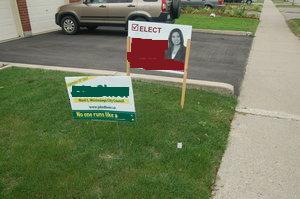 This depends on the type of election. Both the Canada Elections Act (S.C. 2000, c. 9), section 322, and the Alberta Election Act (E.1, RSA 2000), section 135.5 state clearly that no landlord may prohibit a tenant from displaying election advertising posters on the premises nor may any condominium corporation prohibit any owner or tenant from displaying such posters. They do allow the landlord or condominium corporation to set reasonable limits on the size or type of posters and to prohibit such displays in common areas of the building. Common areas are usually those areas that all tenants can access, like the laundry room, parking lot and land surrounding the building.
However, the Alberta Local Authorities Election Act (E-21, RSA 2000), which governs municipal elections makes no reference to election advertising at all, other than to prohibit such displays at polling stations on election day. Many municipalities have bylaws or regulations related to campaign signs on municipal property and roadways. Generally they have no regulations about private property but do caution that placement of signs on private property must have the permission of the property owner. This would imply that in a municipal election the landlord can refuse for a tenant to display a campaign poster or ask a tenant to remove a sign that has been posted. There may even be a term in your lease governing such displays.
Because each province governs both their own elections and their municipalities, these rules may well differ in other provinces.
A Question about Pocket Bikes (mini-motorcycles)
Question of the month from the Garvie Reading Room:
What are the rules about riding a pocket bike in Canada? Can I ride it on the roadway or on sidewalks?

The governing of motor vehicles is a shared jurisdiction: provincial and territorial governments regulate and enforce the licensing, operation, modification and maintenance of all vehicles using public roads while Transport Canada controls the importing of vehicles and motor vehicle safety standards.
Because the rules about what types of vehicles are allowed on public roadways are set by provincial and territorial governments there is not one answer for the whole country. Following are three examples of the rules in three different provinces.
Information for BC comes from the Insurance Corporation of British Columbia who advise that “Mini motor vehicles, commonly referred to as “pocket bikes” or “mini choppers,” do not meet federal safety standards for use on public roads. Their use is limited on public roads to designated parade routes. The reason that these vehicles aren’t generally allowed on public roads is because they don’t meet minimum height specifications for headlamps, tail lamps, stop lamps, and turn signals. They’re also difficult for other motorists to see.”
On a webpage titled “New and Alternative Vehicles”, Ontario Transportation writes that: “Pocket bikes are meant for closed circuit use only, not public roadways. These bikes can be imported as “restricted-use motorcycles.” However, in order to comply with federal standards, pocket bikes require 17-digit vehicle identification numbers, reflectors and warning labels that clearly state these bikes are intended for off-road use only.”
Alberta Transportation has a Fact Sheet which explains that pocket bikes are prohibited motor vehicles meaning that they are not permitted on roadways which includes sidewalks along the roadway. They may only be operated on private property.
If your province is not covered in this article, you could contact your provincial or territorial government department of transportation for more information. A list of links is provided here (scroll down to the Provincial Governments section).
Who pays for heat when utilities are included in the rent?
Utilities, including heat, are included in my rent. Yesterday, my landlord gave me a copy of the heating bill and said that I had to pay for the heat from now on, because the bill was too expensive. Do I have to pay?
No, you don’t have to pay the bill. The lease agreement that you have with your landlord is a contract, and both of you are bound by the terms of the contract. Just like you could not decide to pay your landlord $50 less a month in rent just because you felt like paying less, your landlord can’t tell you to pay more a month. When your landlord agreed to pay the utilities, he accepted the risk that utility costs might increase. The landlord, in order to get more money, could increase the rent. As noted in Service Alberta’s RTA Handbook:
Landlords cannot require tenants to pay utilities after a tenancy has started if the residential tenancy agreement:
• Contains express wording that the utilities are included in the rent,
• Is silent on who is responsible for utilities, but the landlord has always taken a portion of the rent to pay the utilities.
Landlords and tenants can mutually agree that utilities will no longer be included in the rent.
To recover higher utility costs, landlords must give a legal written notice of a rent increase.
But what if your landlord sends you a bill for the heat anyway? You may want to consider writing your landlord a letter, setting out the reasons why you are not going to pay the utility bill. It is a good idea to have things in writing, just in case you end up in a dispute with your landlord. If you are refusing to pay because a term of the lease states that the utilities are included, then attach a copy of the lease with that term highlighted. You could even attach the RTA Handbook section that we already talked about to the letter, so that the landlord can then contact Service Alberta for more information.
If the landlord decides to increase the rent to cover the higher than expected utility costs, then the landlord must follow the rules regarding rent increases. You can read our Rent Increases Tipsheet to find out more information.
Mobile Phone Searches at School
Before I worked at CPLEA as a Program Coordinator I was a teacher. The school I taught in had a strict mobile phone policy. If a student was caught with their phone in class they would have it confiscated. The student would then have to pick up their phone at the end of the day from the Principal’s office.
I was talking to a former teaching colleague about an Edmonton school that went a step further and searched the contents of a student’s phone. My friend wondered if this violated the rights of the student.
Section 8 of the Charter of Rights and Freedoms ensures that everyone has the right to be secure against unreasonable search and seizure (which means that everyone has a right to expect a reasonable amount of privacy). Those that act on the behalf of the government, such as police officers, must act in a fair and reasonable way and usually need a search warrant to do a search.
In schools, the guidelines regarding privacy are a little less strict, as teachers and principals are responsible for student safety. Students are aware that they must comply with school regulations and as a result that they may be subject to searches.
It is sometimes appropriate for teachers and principals to search student property such as backpacks and lockers. Before the search, however, questions such as the following must be considered.
- Is there enough proof to justify the search?
- Is the search reasonable?
- Is the search carried out in a reasonable manner?
CPLEA created a series of lesson plans for schools about the Charter called You Decide: Charter Challenges. The teacher backgrounder that accompanies the lesson plans is an interesting read with more information about Charter rights in schools.
Do you have to tell your landlord if you're going on vacation?
You’ve been dreaming of that perfect vacation for months and it’s finally here: you can practically hear the surf hitting the shore and feel the sun warming your skin while the warm breeze lightly sifts through your hair. Then there’s a knock on your door, interrupting your holiday daydreams and bringing you back to the winter wonderland that is Alberta. Your landlord is at the door, wanting to know if the rumours she’s heard about you leaving tomorrow on a three week vacation are true. If you are leaving for that long, she tells you, then you were supposed to let her know in advance and the rent has to be paid now, instead of on the first of the month, because she wants to make sure that she has the money before you go out of town.
Does the landlord have the right to know when a tenant is going on vacation?
Can the landlord demand that rent be paid in advance of a tenant going on vacation?
Your landlord may have the right to ask for details regarding your vacation plans. The landlord would have this right if there is a term in the lease that provides that the tenant must inform the landlord of absences from the property. The reason that some landlords include this provision within the lease is usually for insurance purposes. Sometimes a landlord’s insurance policy will state that if the rental property is vacant or uninhabited for a period of time, then the insurance will lapse and the landlord would no longer have valid insurance on the property.
You may benefit from letting your landlord know of your absence too. If your landlord knows that you will be away, then the landlord may be willing to drive by the property to check on it, or may be willing to help you with sidewalk cleaning in the winter. Also, it’s a good idea to provide the landlord will the contact information for the person you have checking on the place or house-sitting for you, if you have made those arrangements with someone else. If there is an emergency, the landlord may need to get in touch with you or with the person you designate. If you do not have anyone else checking on the place for you, then you should make sure that the landlord has a reliable way to get in touch with you (and remember, you probably did not provide your landlord with your cell phone number when you moved in).
The landlord cannot demand that rent be paid in advance of the date that the rent is due. The rent is due on a specific day and at a specific time, and the landlord cannot unilaterally change that term without the tenant’s consent. Make sure, though, that you have a reliable way to pay your rent while you are gone. If you pay by cheque, how are you going to get the cheque to the landlord if you’re out of town? Do you have a reliable friend that could deliver the cheque for you? If you pay by email money transfer, do you know that you have a reliable and secure internet connection in the place you are visiting?
You’re probably going to have to clean a foot of snow off your car in the airport parking lot when you get back; you don’t need to be greeted with an eviction notice on your door too.
Can a landlord charge a tenant for renovations?
I just got a question from a tenant. The landlord replaced all the windows in the rental property, and then gave the tenant a bill for half the cost of the renovations. Seriously.
The tenant doesn’t have to pay the landlord the money. There are some costs that are simply the costs of doing business, and maintaining the property by replacing windows is just one of many costs this landlord is going to run into.\
If the tenant had broken a window because, I don’t know, there was an intense game of indoor baseball going on, then yes, for sure, the landlord could charge the tenant for the repair and replacement of the window. Or the landlord could charge the tenant when the tenant moved, and keep some of the security deposit to cover the cost.
The Residential Tenancies Act doesn’t actually set out who is responsible for repairs and that’s why sometimes, there is confusion about what repairs the landlord can charge the tenant for, and what repairs the landlord can’t charge for. The common sense approach is that any “big” repairs are the landlord’s responsibility and “teeny tiny” repairs are the tenant’s responsibility. So, while the tenant can change the lightbulb, it’s the landlord that installs the new light fixtures when the old ones break.
There is also the Minimum Housing and Health Standards that can help us to decide who should pay for repairs. One of the landlord’s responsibilities is to make sure that the rental property meets these standards. The standards set out that the windows must be in good repair, free of cracks and weatherproof. So, if the windows in the property do not meet this standard, then it’s the landlord’s job to make sure that the windows get repaired or replaced. If the property is not being maintained, then the tenant can call Environmental Public Health and talk to an inspector about the problem that they’re having with the rental.
What should the tenant do? The tenant should tell the landlord, in writing, that they are not going to pay for the windows. The tenant could put in reasons why they aren’t paying (and while it might be tempting to write that you aren’t paying because the charge is ridiculous, it’s probably better to refrain). Hopefully the landlord will just go away at this point. If the landlord still insists on being paid, then there are three ways the landlord may react.
- The landlord could sue the tenant for half of the cost of the renovation. The landlord is going to have to convince a judge that the tenant should have to pay for the windows, which seems unlikely.
- The landlord could keep the security deposit when the tenant moves out. If the tenant doesn’t agree with a charge made against the security deposit, then the tenant can bring an application in Provincial Court or through the Residential Tenancy Dispute Resolution Service for return of the security deposit.
- The landlord could pass the bill to a collection agency. If the tenant is contacted by a collection agency, then the tenant can inform the agency in writing that the tenant is disputing the debt, and ask that the landlord prove the debt in court. If the tenant does that, then the collection agency cannot contact the tenant any longer. Service Alberta has a tipsheet about dealing with collection agencies.
In the meantime, the tenant might want to think about moving. If the landlord thinks that the tenant should pay for the windows, what else does he think the tenant should pay for?