CPLEA.CA

  • Contact
  • About
    • Board of Directors
    • Work with CPLEA
    • Funders
    • Staff
    • Volunteers
  • Our Work
    • Justice Navigator Training
    • Websites
    • What’s New
    • Workshops
    • Community Consultations 
  • Legal Topics
    • Abuse & Protection
    • Condominium Law
    • Consumer, Money and Debt
    • Family & Relationships
    • Housing
    • Planning for Future Care
    • Resolving Disputes
    • Recreation
    • Ressources en français
    • Wills & Estates
    • Work

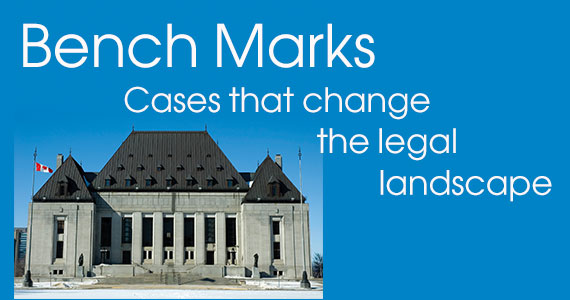
LawNow 38-6 Bench Marks: Cases that Change the Legal Landscape

July 14, 2014 By CPLEAadmin

Bench Marks: Cases that Change the Legal Landscape

Featured Articles: Bench Marks: Cases that Change the Legal Landscape


Some decisions our courts make carry the possibility of changing lives (same-sex marriage) and defining our institutions (the Senate).  This issue looks at a few of these “Bench Marks”.
Landmark Cases: Cases which have changed the Legal and Social Landscape of Canada
Some cases have had the effect of changing not only the legal but also the social landscape of Canada. Here is a look at a few of them.
The Increasing Importance of Reference Decisions in Canadian Law
Reference Decisions, from the Senate Question to the Nadon decision, are increasingly important in Canadian jurisprudence.
Supreme Court Reins in Social Credit
This 1938 case has echoed through history with its powerful support for freedom of expression and freedom of the press as necessary aspects of our constitutional democracy.
The Whatcott Case: Balancing Free Speech and Social Harmony
The Whatcott decision highlights the clash of Charter values when evaluating hate speech.

Special Report: Aboriginal Law


Indian Residential Schools: A Chronology
From 1755 to 2014: a timeline of the Residential Schools tragedy.
The Indian Act – Exemption from Taxation
Interpretations and court decisions have shaped the income tax rules for Canada’s aboriginal people.
Aboriginal Children and Child Welfare Policies
The Residential Schools program scarred generations of aboriginal children. Today, child welfare policies have the potential to cause damage too.

Departments


Viewpoint
A Bench Mark case indeed!
Ask a Law Librarian
Researching Aboriginal Law

Columns


Human Rights Law
Human Rights of Transgender Persons
Not-for-Profit Law
New Legislation Eases Moves Into or Out of Alberta for Not-For-Profits
Employment Law
Compassionate Care: A New Basis for Temporary Unpaid Leave from Work
Landlord and Tenant Law
Can a landlord charge a tenant for renovations?
Family Law
Protection Orders in Dangerous Circumstances
A Famous Case Revisited
Whatever Happened to … Childs v. Desormeaux: Killer Hospitality

Filed Under: Blogosaurus Lex Tagged With: Aboriginal Law, Benchmark Cases, constitutional law, LawNow, Reference Decisions, residential schools, Supreme Court of Canada, The Charter

New FAQs on Consumer Protection in Alberta

July 10, 2014 By CPLEAadmin

What are collection agencies and collectors allowed (and not allowed) to do?
What’s the difference between an open credit agreement and a fixed one?
What information cannot be included in a credit report?
You can find the answers to these questions and more on Canadian Legal FAQs.
There can be a lot of questions when people are dealing with consumer issues. In Alberta, consumer transactions are governed under the Fair Trading Act.
The Act covers a variety of different areas and provides rules and regulations that set out what businesses can and cannot do in their interactions with consumers. It also provides a way for consumers to challenge a transaction with an offending business and to be awarded a remedy, such as cancellation of a transaction, payment of damages, and others.
Two major areas of focus of the Fair Trading Act are Collection and Debt Repayment and Cost of Credit Disclosure.
CPLEA has created new FAQs on Consumer Protection to help Albertans understand what the law says about:

  • The Fair Trading Act
  • Collection and Debt Repayment
  • Cost of Credit Disclosure
  • Credit and Personal Reports

 
For more information about organizations that can provide information and assistance around issues facing consumers in Alberta, check out CPLEA’s LawCentral Alberta.

Filed Under: Blogosaurus Lex Tagged With: Alberta law, Canadian Legal FAQs, Collection Agencies, consumer law, consumer protection, credit disclosure, debt repayment, Law FAQs, the Fair Trading Act

Questions about CASL?

June 3, 2014 By CPLEAadmin

Is your registered charity or not-for-profit ready for the Canada’s Anti-Spam Legislation (CASL)? Many organizations are concerned about ensuring they comply with the new legislation. Luckily, new resources from CPLEA can help!
CASL stands for Canada’s Anti-Spam legislation. This anagram is the unofficial name for a new law recently passed by the Parliament of Canada. The official name of the law is “An Act to promote the efficiency and adaptability of the Canadian economy by regulating certain activities that discourage reliance on electronic means of carrying out commercial activities, and to amend the Canadian Radio-television and Telecommunications Commission Act, the Competition Act, the Personal Information Protection and Electronic Documents Act and the Telecommunications Act (“The Act“).
CASL comes into force on July 1, 2014. Because it is a federal law, it will apply to not-for-profit organizations and registered charities across Canada.
CPLEA has created new FAQs and resources to help registered charities and not-for-profits understand and comply with CASL. Check out the website to for information on:

  • Key Provisions
  • Regulators
  • Penalties
  • Timelines
  • Definitions

 
While the unofficial title of the Act targets spam, it is actually much broader in scope. CASL deals with commercial electronic messages (CEMs) and it regulates a broad range of activities including:

  • unsolicited commercial messages such as emails, texts and tweets;
  • hacking, malware and spyware;
  • “phishing” and other fraudulent or misleading practices;
  • invading privacy through a computer; and
  • collecting email addresses without consent.

Registered charities and not-for-profit organizations may discover that many of the communication tools that they have routinely used over many years will now be subject to the provisions of this Act. The new information and resources from CPLEA will help organizations prepare and cope with the coming changes.

Filed Under: Blogosaurus Lex Tagged With: accountability, charity law, new resources, Technology

Organ Donation – make those wishes clear!

April 24, 2014 By Carole (Staff Lawyer)

For those of you who have read our booklet about Personal Directives, or attended one of our seminars about this issue, you already know that in order to donate your organs you have to plan for it and you have to give written permission.
In other words, your Agent (that’s the person you’ve nominated to make your personal decisions for you once you no longer can) cannot consent to organ donation unless you have given him/her written instructions to do so.
Until yesterday, there were two ways to do that in Alberta: sign the back of your healthcare card and/or put the instructions in your Personal Directive.
This week, the Government of Alberta announced a new way – an online organ donation registry.
The Alberta Organ and Tissue Donation Registry is already up and running. To register you have to provide your health care number and your birth date. You will then be asked if you wish to donate all of your organs and tissues, or only certain ones.
But, it does not end there.
Once you have completed these first few steps, you will be asked to print off a legal consent form, which you must then sign, have witnessed, and mail in. This second part of the process is essentially meant to meet the criteria of needing written permission. Presumably, it is intended as a form of security to ensure that no one other than you made the choice for you (and possibly without your knowledge).
The question then arises, what happens if you don’t send in the legal consent?  Presumably, when the time comes, your Agent will argue that filling in the online form should be enough. However, if there is another loved one who happens to oppose organ donation, s/he may try to argue that there has not been valid consent..
For example,  a person who opposes the decision to donate could say that it was not you that filled in the online form, or that you no longer had capacity when you filled it in. What would happen next?  Hard to say. Generally, the law likes evidence…and if you have people willing to fight the issue, the question of evidence will be of great importance. (Remember – at this point you will no longer be able to clarify).
So what can be done to maximize the chances of your wishes being carried out? A few ideas include:

  • sign the back of your Alberta health care card (even though your wishes might be recorded elsewhere);
  • register online and remember to mail in the consent form (and consider keeping a copy for your files); and
  • write a Personal Directive (PD) and include your wishes in it as well.  Including your wishes for organ donation in your PD  has a few additional bonuses:
  • In a PD you can add additional thoughts you have on the matter. For example, whether you want to donate your organs after brain death, or only after cardiac death.
  • In a PD you can explain more about exactly what you want and why you want it. While you are writing the PD, you can have a family meeting and discuss these thoughts and wishes your with loved ones. All of this, will make it easier for your Agent when the time comes to actually consent to the harvesting of your organs.Remember, at the moment of the decision, your Agent probably won’t have either your health care card or the online form in his/her hand, and s/he may need proof to show to anyone opposing the decision.  Having and hearing the additional information may also help family members to better understand your decisions (and perhaps make it less likely they’ll be opposed?)

So make those wishes clear. Your loved ones will be glad you did!

Filed Under: Blogosaurus Lex Tagged With: Personal Directive, Wills and Estates

The Neighbour Series Part 4: Shooting at Magpies

April 22, 2014 By Carole (Staff Lawyer)

The television series Friends was an iconic show that, oddly enough, touched on some interesting law-related issues.  In seasons 5 there was an episode where Phoebe and her police-officer boyfriend were rudely awakened by a squawking bird.  Phoebe’s boyfriend nonchalantly pulled out his gun and shot the bird, much to her dismay. magpie
We know many people that have considered treating pesky magpies in this manner: especially in the spring, when they so loudly protect their nests, and feed their young with the babies of other birds. But what would happen if one were to do this in Alberta?  Would it be a violation of any bylaws? Or criminal laws even?
What birds are protected?
The starting point for figuring out if you can shoot a bird is to look to see if there are any laws protecting birds.
In Alberta, the federal Migratory Birds Convention Act and the Migratory Birds Hunting Regulations combine to protect the majority of birds.  The Alberta Guide to Hunting Regulations further explains which birds a hunter needs a license to shoot.  A non-exhaustive list of exceptions to this licence rule includes birds like magpies, pigeons, and crows.
But even if you shoot one of these exempt birds you have to be mindful because you might be caught violating one of many firearm laws.
What levels of government govern firearm laws?
The federal government, provincial governments and individual municipalities all have laws governing firearm use.  The federal government regulates firearms through the Firearms Act and Part III of the Criminal Code of Canada. These laws work together to ensure that firearms are properly registered and used safely.
The provinces have the power to make laws governing hunting, and they have often used this power to govern firearm use.  In Alberta, firearm use in the province is regulated by the Alberta Wildlife Act.  This Act covers multiple issues including the prohibited use by minors unless under the supervision by a guardian or someone similar (section 31(1)).
At the municipal level many cities have crafted bylaws controlling firearms within their limits.  For example, section 9 of Edmonton’s Public Places Bylaw outlaws the possession and firing of any weapon capable of shooting a projectile in public places, and in Strathcona County there is a bylaw that prohibits the use of firearms within the urban area.
So can I shoot that annoying magpie?
Whether or not you can shoot that annoying bird will largely depend on where you live.
Under certain circumstances you can discharge a properly registered firearm on your property if you live on a farm where there aren’t any bylaw or safety issues.
This becomes less likely if you live in a densely populated area. For example, section 86(1) of the Criminal Code prohibits careless use of a firearm and section 52(1) of the Alberta Wildlife Act prohibits discharging a firearm within 200 yards of an occupied building under most circumstances.  Finally, your city or town might also have bylaws that regulate the use of firearms. Some even apply when on private land like in Strathcona County.
Other solutions
Just because you can’t simply shoot that annoying bird carte blanche, that doesn’t mean that there are not some viable solutions. Across the province, there are many cities that employ animal control officers to assist in dealing with pests like birds.  For example, in Edmonton there is the Animal Care and Control Centre. They can help you legally trap pest animals such as skunks, porcupines, squirrels, ground squirrels, magpies, and crows on your own property.
Crows and magpies can be particularly annoying.  Alberta Fish and Wildlife explains that they will eat anything and it is important to keep garbage secure or they may venture on your property.  You can also trim your trees until the cover they provide is too thin to provide protection for larger birds or use frightening devices like scarecrows or hawk kites.
So you may want to think twice before shooting that annoying bird because you may end up doing more than just ruffling a few feathers.
This is a guest post by Cameron Mitchell, a third year law student who is volunteering with the Centre for Public Legal Education Alberta.

Filed Under: Blogosaurus Lex Tagged With: bylaws, municipal bylaws

Bench Press: Vampire Slayer Victim of a “cruel and unforgiving illness.”

April 15, 2014 By Teresa (Editor, LawNow)

Glen Race murdered two Halifax men in 2007. He pled guilty to both charges and then made an application to be found not criminally responsible (NCR).
Mr. Justice Kevin Coady of the Supreme Court of Nova Scotia reviewed the law and the legal requirements for a convicted person to be found not criminally responsible. He concluded that Mr. Race suffered from a mental disorder that made him incapable of knowing that his actions were wrong.  In his case, three psychiatrists, both for the Crown and the defence agreed that Mr. Race qualified for a finding of NCR. An agreed statement of facts from the three doctors stated that he suffered from schizophrenia and that he believed he was a vampire slayer and a godlike entity ordered by angels to cleanse the world of demons and sin.
Justice Coady wrote: “After considering all of the evidence, I am satisfied that Mr. Race qualifies for an NCR defence…He suffered from a mental disorder on both occasions, that being schizophrenia. I am also satisfied that Mr. Race, as a result of his mental disorder, did not realize that these actions were morally wrong. I am satisfied that he really believed they were necessary to achieve his psychotic mission.”
Justice Coady made two other interesting observations. First, he reached out to the families of the murdered men and said that in the context of a NCR finding: “It is important to realize that Mr. Race, his family, and friends are victims as well. They are victims of a cruel and unforgiving illness of schizophrenia. Given that there is no cure and that Mr. Race’s case is so severe, their victimization will continue for the rest of their lives. This in no way minimizes the pain and loss the Knott and Brewster families have, and will continue to, experience. These homicides are different than most killings in that the perpetrator and the victims are victims.”
Then, Justice Coady added: “It is important to note that an NCR finding is not an acquittal. Mr. Race will be held responsible for killing Paul Knott and Trevor Brewster. There will be consequences for those actions and those consequences will continue for the rest of his life.”
R. v. Race, 2014 NSSC 6 (CanLII)
Article originally published in LawNow magazine, March/April 2014 issue. For more articles on contemporary issues with a legal perspective, see the LawNow website at https://www.lawnow.org/.

Filed Under: Blogosaurus Lex Tagged With: Bench Press, case law, LawNow

Elder abuse: Resources that can help

April 3, 2014 By Carole (Staff Lawyer)

This morning on the news, we heard the sad news of yet another older adult being financially and emotionally abused.
As the baby boomers age, fertility rates decrease and life expectancy increases, Canada is becoming an ‘older’ country. According to Statistics Canada, the number of Canadians aged 55 and older will rise from 27% in 2011 to 35% in 2031. In addition, a growing number of those over 55 are reporting that they are the victims of abuse. In 2007, Statistics Canada reported that the overall rate of police-reported violence against seniors increased by 20 per cent between 1998 and 2005.
Elder abuse can take various forms, including financial abuse, physical abuse, psychological abuse, medication abuse and neglect. It can be perpetrated by various people:  today’s story was about a stranger turned employee, but often, it is done by a family member.
So what can be done? Although elder abuse is never a victim’s fault (the fault lies with the abuser), there are steps that older adults can take to try to prevent or to help stop abuse. A key factor in keeping able to take these steps is understanding how the law can help. Everyone has the right to know about the law and how it affects them. To know about the law is not a luxury. It is only when people know about the law that they are able to use it protect themselves and others. While our legal system alone cannot completely stop elder abuse, it is a valuable component of any strategy to stop abuse.
At CPLEA, we have various resources that can help.

  • To become more empowered about end-of-life issues (and therefore take steps to minimize the likelihood of abuse, we have resources about Powers of Attorney, Personal Directives, Wills and formal arrangements for help with decision-making. Within these resources are also explanations about various financial tools, such as joint bank accounts and signing a guarantee: how they can be helpful, but how they can be used to abuse.
  • To learn more about the jobs that are given under Powers of Attorney, Personal Directives and Wills, and on how to do those jobs within the law and without crossing the lines into abusive behaviours, we have booklets on being an Attorney, being an Agent and being an Executor.
  • To learn more about identifying and addressing abuse, we have a booklet of Frequently Asked Questions about elder abuse, a portion of one of our websites (the Older Adult Knowledge Network), dedicated to information about elder abuse, including first-person stories and information about how things will proceed if an older adult does decide to report abuse to the police.

And we are developing more resources. We are currently working workshop materials to address how the law can be used to help prevent and stop abuse. Check back with us next spring.
Although elder abuse is not a pleasant topic, if we want to maximize the chances of our aging well it is certainly one worth learning about.

Filed Under: Blogosaurus Lex Tagged With: Elder Abuse

Bench Press: “Ski Buddy” Liability

April 3, 2014 By Teresa (Editor, LawNow)

Mark Kennedy of Colorado died on a heli-skiing expedition when he fell into a tree well.
His widow claimed that he had been paired with a “ski-buddy” who was contractually obliged to stay close to him, keep him in sight and assist or alert guides and other skiers if he saw that his buddy needed help. She also alleged that the buddy, Adrian Coe, owed a duty of care in tort law to Mark Kennedy. She sued Mr. Coe for loss of future earnings over her husband’s death.
Madame Justice Fisher of the British Columbia Supreme Court dismissed the action. She found that just because the two men had been paired to ski together there was no basis to find that there was a contract between them. Similarly, she ruled that Mr. Coe did not owe a duty of care to Mr. Kennedy, and that even if there were, Mr. Coe would have met the standard.
She summarized: “It is indeed very sad that Mr. Kennedy met a tragic and untimely death, but he did so while participating in a high-risk sport and responsibility for his death cannot be placed on Mr. Coe.
Kennedy v. Coe, 2014 BCSC 120 (CanLII)
Article originally published in LawNow magazine, March/April 2014 issue. For more articles on contemporary issues with a legal perspective, see the LawNow website at https://www.lawnow.org/.
 

Filed Under: Blogosaurus Lex Tagged With: Bench Press, case law, LawNow

Truth and Reconciliation: Alberta National Event

March 25, 2014 By Margo (Associate Director)

Truth and Reconciliation Commission of Canada
The seventh and final Truth and Reconciliation National Event takes place in Edmonton, March 27-30, 2014.
In the words of the TRC Commissioners “TRC events provide an important opportunity for those affected by the legacy of the Indian Residential Schools to share their experiences with the Commission and the public. They also serve to educate Canadians about the country’s 130-year history of residential schools, and their legacy for Aboriginal communities and Canadian society as a whole.”
All TRC events will be held at the Shaw Conference Centre, 9797 Jasper Avenue, Edmonton. The Alberta National Event will also be livestreamed at www.trc.ca.
No registration is needed to attend. Those wishing to provide a statement to the Commission may register onsite during the event.
The full program for the event is available on the website for the Truth and Reconciliation Commission of Canada Alberta National Event.

Filed Under: Blogosaurus Lex Tagged With: residential schools, Truth and Reconciliation Commission of Canada

March/April 2014 Issue of LawNow: Language and the Law

March 24, 2014 By Teresa (Editor, LawNow)

LawNow Mar/Apr2014: Language and the Law

Featured Articles: Language and the Law

The choices we make in language – words, even punctuation – can shape legal results.


Comma Law
Peter Bowal and John Layton
Sometimes, for want of a comma, the lawsuit is lost!
You Can’t Do or Say That: Constraining Individual Conduct in a Public and Commercial World
Hilary Findlay
Morality clauses in contracts use language to describe unacceptable conduct and both parties to the deal have important interests in what the words say.
The Intersection of Law, Language and Culture
Carole Aippersbach
In Canada, the question of ‘language rights’ is a very important part of our legal landscape.
Quebec’s Need for Cultural and Linguistic Protection, the Notwithstanding Clause and the Demise of Meech Lake
Rob Normey
Quebec’s language laws operate in tandem with laws designed to protect Quebec’s culture.
The Multicultural Family Law Facilitator’s Project
Nayanika Kumar
This project addresses one Canadian city’s response to a crisis in (mis)interpretation in Canadian courts.


Special Report: Disabilities and the Law

A Progress Report of Disability Rights since the Charter 
Marjun Parcasio
Much progress has been made on the legal rights of the disabled since the Charter became law in 1982, but much could still be done.
Meaningful Access: Students with Learning Disabilities Strive to be Included
Melissa Luhtanen
One British Columbia family fought all the way to the Supreme Court of Canada to clarify the law on learning disabilities.
Tax Assistance for Persons with Disabilites
Joseph R. Devaney
Canada’s Income Tax Act has a number of provisions for tax benefits for disabled Canadians and their caregivers.
Persons with Disabilities and the Law – Resources for Research
Alberta Law Libraries
Librarians at Alberta Law Libraries can help with research into many aspects of disability law.  Just ask them!
 Departments


Viewpoint
Mothering with Disabilities
Shahnaz Rahman 

Columns

Human Rights Law
Freedom of Association and Collective Bargaining: Are the Justifiable Limits?
Linda McKay-Panos
Not-for-Profit Law
Organization Launched to Foster Canadian Charity Law
Peter Broder
Employment Law
Insubordination and Dismissal
Peter Bowal and Laine Robson
Landlord and Tenant Law
Coming  in April …
Rochelle Johannson
Family Law
A Brief Primer on Child Support: Part One
John-Paul Boyd
Criminal Law
Criminal Defence Law in the North: Part Two
Charles Davison
Online Law
Protecting Yourself from Consumer Fraud and Scams
Margo Till-Rogers
A Famous Case Revisited
Whatever Happened to … The Law of Sniffer Dog Searches: Part 2
Peter Bowal and Evan Knight

Filed Under: Blogosaurus Lex Tagged With: disabilities, language, LawNow Magazine

  • « Previous Page
  • 1
  • …
  • 3
  • 4
  • 5
  • 6
  • 7
  • …
  • 16
  • Next Page »

What’s New

Get up-to-date on the latest news and upcoming events at CPLEA

Sign up for our monthly newsletter!

Order Free Print Copies

Every year we send out thousands of free printed resources about the law in Alberta.

Just ask, and we'll do the printing for you!

Order Free Print Copies of our Legal Resources

Territory Acknowledgement

The Centre for Public Legal Education respectfully acknowledges that we are located across Treaty 4, 6, 7, 8 and 10 territories, and respects the histories, languages, and cultures of First Nations, Métis, Inuit, and all First Peoples of Canada, whose presence continues to enrich our vibrant community.

Funders & Partners

alf-logo_tn
sof-logo_tn
sof-logo_tn
Terms of Use