CPLEA.CA

  • Contact
  • About
    • Board of Directors
    • Work with CPLEA
    • Funders
    • Staff
    • Volunteers
  • Our Work
    • Justice Navigator Training
    • Websites
    • What’s New
    • Workshops
  • Legal Topics
    • Abuse & Protection
    • Condominium Law
    • Consumer, Money and Debt
    • Family & Relationships
    • Housing
    • Planning for Future Care
    • Resolving Disputes
    • Recreation
    • Ressources en français
    • Wills & Estates
    • Work
Home / Archives for constitutional law

Senate Series Part 1: An Introduction to the Senate

August 2, 2013 By Margo (Associate Director)

The following is a guest post by Vani Govindarajan, a third year law student who is volunteering with the Centre for Public Legal Education Alberta.
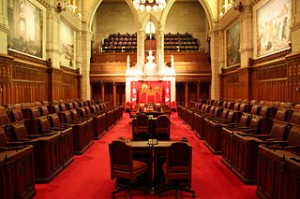
The chamber of the Senate of Canada
There has been quite a furor about the Senate this summer. We’ve heard about everything from expenses and audits, ethics and accountability, to possibilities for election, appointment, reform, and abolition.
But what is the Senate? What does it do? Why do we have one? A series of blog posts this summer will try to answer some of these key questions to help us understand the Senate and all the discussion about the bigger questions of whether we should to keep it as is, reform it, or even need it at all.
Let’s start with some basic information.
What is a “senate”?
The word senate comes from the Latin word ‘senatus’ and means council of old men. However, Canada’s Senate is now composed of both men and women, after the Privy Council in London declared that women were ‘persons’ (click here to read our post about the Persons Case.). And while many would agree that 35 years old is not ‘old’, a senator must be at least that age before he or she can be appointed to the Senate. In contrast, someone can be elected to the House of Commons at age 18.
As an aside, Canada’s Senate is sometimes called the “red chamber” because of the chamber’s decor. Red is the colour of royalty and the Senate chamber is where the King comes to visit Parliament.
What is the difference between a Senate and Upper Chamber?
Canada’s federal Parliament has a bicameral Legislature, meaning it has two chambers or houses. The Senate is the name given to the upper chamber. The lower chamber is the House of Commons. These two houses, together with the King, form the Parliament of Canada.
The Constitution Act, 1867 sets out that the Upper House is to be called the “Senate” and its members “Senators”. Canadian provinces and other countries have given other names to the upper house or chamber. For example, provincial governments before Confederation, including the Province of Canada, called their upper chambers “Legislative Councils”. In the United Kingdom, the upper chamber is called the House of Lords.
Why do we have a Senate in Canada?
The preamble of the Constitution Act, 1867, formerly the British North America Act, 1867, explains the objective of adopting a constitution “similar in principle” to that of the United Kingdom. Canada’s Parliament is modelled after the United Kingdom’s Parliament, which has two houses: the House of Commons and the House of Lords.
While Parliament was to be similar in principle to the UK Parliament, there are some differences in how the Canadian Senate is modelled. The first is that representation in the Senate is based on regions. Another difference is that Senate positions are not hereditary appointments and so the number of Senators is fixed. As a young country without a land-owning aristocracy, there was no ability to attach a position in the Senate to title, and appointment or election became the only real options for selection to the Senate.
Purpose of the Senate
Even during negotiations at Quebec in 1864, the ‘Fathers of Confederation’ were far from being in agreement on representation or on the selection of Senators and that was partly because of different views of its potential role.  The Senate that was ultimately created may be said to have had two major functions.
The first was to review and revise legislation and be a check against the political majority in the House of Commons. It is this function that the first Prime Minister Sir John A. MacDonald was referring to when he said the Senate was to be the house of “sober second thought”.
A second major purpose of the Senate was to represent the regions in a new Confederation. Lower Canada (Quebec) and the Maritime colonies were concerned with protecting historical, linguistic and religious identities, as well as local economic interests. The House of Commons was to be governed by the principle of ‘representation by population’ (which had not been the case in the Province of Canada) and, fearing the dominance of Upper Canada (Ontario), smaller provinces demanded equality in the Senate.
Do any of the provincial legislatures have senates?
Not anymore. Many pre-Confederation colonies had elected upper chambers, known as Legislative Councils. Most were appointed although Prince Edward Island had an elected Legislative Council.  The Province of Canada appointed its members until 1856, after which new members were elected for life terms. One of the biggest reasons why provinces with an upper chamber have since abolished it is the expense of maintaining a second body. As well, there was often a challenge to find qualified people because the Governor-General would often choose senators from provincial upper chambers. Quebec was the last province to abolish its upper house in 1968.
Answers or More Questions?
This post may have left you with more questions: what rules are in place to achieve regional representation? Did the ‘Fathers of Confederation’ make similar arguments about whether the Senate should be appointed and elected body that we are still having today? The next post will look at how someone can become a Senator…and how they can be disqualified.
Further reading:

  • About the Senate, according to the Senate: http://sen.parl.gc.ca/portal/about-senate-e.htm
  • A Background on the Senate: http://www.cbc.ca/news/canada/story/2010/07/09/f-senate-background.html

Filed Under: Blogosaurus Lex Tagged With: constitutional law, Senate

It's my right! / C'est mon droit!

March 13, 2013 By Margo (Associate Director)

Check out CPLEA’s newest resource – It’s My Right! Constitutionally Protected Minority Language Rights Outside of Québec.
Whether we are born in Canada or move here later in life, we learn that this is a bilingual country. We also learn that minority official language speakers (the French language minority outside of Québec, and the English language minority inside Québec) have “rights” and that these rights are sometimes protected by Canada’s constitutional framework (including the Charter).
But what exactly are these rights and when exactly do we have them? Are these rights always constitutionally protected, and, if not, what are the differences between the kinds of rights? Are there times when an official language minority issue is not question or “right”?
This booklet is for people who would like to learn more about their constitutionally-protected French language minority rights outside of Québec. The issue of English language minority rights inside Québec will not be addressed in any detail. This booklet gives general information only, not legal advice. This booklet is available in both French and English.
Now available at pub.cplea.ca.

Découvrez la ressource la plus récente  de CPLEA :
C’est Mon Droit!  Les droits linguistiques des minorités de langues officielles (à l’extérieur du Québec)
Que l’on soit né au Canada ou que l’on s’y installe plus tard dans la vie, on apprend qu’il s’agit d’un pays bilingue, que les membres de la minorité de langue officielle (la minorité de langue française à l’extérieur du Québec et la minorité de langue anglaise au Québec) ont des « droits » et que ces droits sont parfois protégés par le cadre constitutionnel du Canada (incluant la Charte).
Mais que représentent exactement ces droits et quand peut-on les utiliser exactement? Sont-ils toujours protégés par la constitution, sinon, quelles sont les différences entre les divers types de droits? Y a-t-il des moments où une question concernant la minorité de langue officielle n’est pas une question de « droit »?
Ce document s’adresse à tous ceux qui désirent en savoir davantage sur les droits constitutionnellement protégés de la minorité de langue française à l’extérieur du Québec. La question des droits de la minorité de langue anglaise au Québec ne sera pas abordée en détail. Ce document propose uniquement des renseignements d’ordre général, et non des conseils juridiques. Il est disponible en français et en anglais. Vous trouverez ci-après des questions fréquemment posées sur les droits linguistiques constitutionnels des minorités francophones au Canada.
Maintenant disponible à: pub.cplea.ca.

Filed Under: Blogosaurus Lex Tagged With: constitutional law, minority official language rights

LawNow Magazine's Latest Issue: Constitutions and Developments in Internet Law

January 11, 2013 By Kristy (Communications Coordinator)

The latest issue of LawNow is available

Full PDF of the issue
 
The Feature Articles in this issue is on Constitutions.
Do Constitutions matter? Indeed they do. Just ask the Egyptian people protesting, confronting, and even dying over the drafting of their new constitution..
The Special Report looks at developments in internet law.
 

Table of Contents


Featured Articles: Constitutions

Evolution, Not Revolution: Canada’s Constitutional History and the Constitution Act, 1867
Some constitutions are born of revolution, some of evolution. Canada is a fortunate nation: our Constitution has evolved.
O Patria: The Patriation Struggles
Bringing home our Constitution has forever shaped our national political and legal landscape.
The Canadian Charter of Rights and Freedoms: An Integral Part of our Constitution
Canada’s Constitution and our Charter of Rights work together to create our laws and protect our rights.
The Constitutions of the Maritime Provinces
Constitutions are essential documents in Canada’s Maritime provinces, reflecting history and defining the present.
Bills of Rights in Canada
The federal government and the provinces have bills of rights, human rights codes, the Charter and the Canadian Bill of Rights 1960. It gets a bit confusing!


Special Report: Developments in Internet Law

Privacy and Cloud Computing
When do clouds not refer to the weather? When they are a term for Internet storage!
Canada’s New Anti-Spam Legislation: What to Expect
What do you or your business need to know about this new law?
Defamation by Hyperlink
The Supreme Court of Canada described some of the interactions of the law and the Internet as “trying to fit a square archaic peg into the hexagonal hole of modernity”.


Departments

Viewpoint
Let’s hear more indigenous success stories
Bench Press
Special Needs; Special Education
Two Spouses; One Deceased
Trial Judge Plagiarism
Sperm Donor Dads Remain Anonymous


Columns

Human Rights Law
The Supreme Court of Canada Changes Direction
Family Law
Relocation Advisory Guidelines – an idea whose time has come?
Employment Law
The Confidentiality of Commercially Valuable Information
Online Law
Who Cares about Internet Law and Policy?
Not-for-Profit Law
Proposed Bill, Though Well-intentioned, Raises Questions
What Ever Happened to … A Follow-up to Famous Cases
R. v. Sault Ste. Marie: The Due Diligence Defence
Landlord and Tenant Law
Renting with a Pet

Filed Under: Blogosaurus Lex Tagged With: constitutional law, Internet law, LawNow

How about now? Now, is assisted suicide legal?

August 16, 2012 By Carole (Staff Lawyer)

Scales of JusticeA few weeks ago, we wrote a blog post about the British Columbia Supreme Court (BCSC)’s decision regarding assisted suicide. As mentioned in that post, as well as in our subsequent post about constitutional exemptions, the original decisions were already in the process of being appealed.
You will recall that the BCSC made two findings:

  • that section 241(b) of the Criminal Code of Canada (“s.241(b)”) is unconstitutional, because it discriminates against persons with disabilities (but that that law would remain in effect in one year, thus giving the government time to deal with the declaration of invalidity); and that
  • in the interim, in order to provide Ms. Taylor with the only meaningful remedy, she was granted a constitutional exemption (i.e.: despite the law still being in effect, she could, during the next 12, commit physician-assisted suicide).

The finding of unconstitutionality is set be heard by the British Columbia Court of Appeal (BCCA) in early March 2013. In the meantime, the parties agreed to argue about the  issue of the constitutional exemption. The exact issue in question: whether or not to grant a “stay” to the constitutional exemption (i.e.: put the exemption on hold until the whole matter is heard next March [in other words, take away Ms. Taylor’s constitutional exemption]). The parties’ submissions were heard on August 3, 2012 and a judgment was issued on August 10, 2012.
In short, the constitutional exemption stands. Between now and the time at which the BCCA decides on the issue of the constitutionality, Ms. Taylor is free to find a doctor to help her commit suicide, and, if she does, that doctor will be exempt from prosecution under s.241(b).
Why? Well that is a little more complex. In a nutshell , in deciding whether to grant a stay, the Court, in accordance with the law governing the granting of stays, had to look at 3 things (there is almost always a 3-part test!):

  • whether there was a serious question to be tried;
  • whether Ms. Taylor would suffer  “irreparable harm” if the stay were granted (i.e.: if her constitutional exemption was taken away from her); and
  • whether the “balance of convenience” favours granting the stay.

So what did the Court say? Not surprisingly, on the first question, it found  that the issue was, indeed, quite serious.
On the second issue, the Court noted that Ms. Taylor would suffer irreparable harm. Madame Justice Prowse noted:

The first, and most significant, is the irreparable harm which she would suffer if her condition deteriorated to the point where she wished to exercise her rights under the exemption pending the resolution of this appeal, but, because of the stay, she was unable to do so.  In that circumstance, all of her worst fears would be realized and she would be forced to endure the very death which she has fought so assiduously to avoid […]The second category of irreparable harm […] is the loss of the peace of mind and solace now available to her as a result of the exemption, in knowing that if living becomes unbearable to her for any of the reasons she has given, she can bring her life to an end upon fulfilling the requirements set forth in the order governing the exemption.  The exemption also gives her the potential for a longer life since she can continue to live, even in difficult circumstances where she may be incapable of ending her own life, if she still enjoys some quality of life which she considers makes it worth living.

On the third issue, the court found that this potential harm to Ms. Taylor, would outweigh any harm that would come to the federal government if Ms. Taylor were allowed to keep her constitutional exemption. The Court, in responding to the government’s argument that allowing Ms. Taylor’s suicide would appear to the Canadian public as “state-sanctioned” devaluation of human life stated: “I am not persuaded that the harm to the public […] outweighs the harm to Ms. Taylor if she is left without a remedy pending the resolution of this appeal, and possibly at all.  She may be a symbol, but she is also a person, and I do not find that it is necessary for the individual to be sacrificed to a concept of the “greater good” which may, or may not, be fully informed.”
So how do we summarize this decision in one sentence?
Well…. Allowing the one physician-assisted suicide may cause the government some harm, but the harm to Ms. Taylor of not letting her do it is worse – so she wins.
The answer, then? No. Unless you are Ms. Taylor, physician–assisted suicide is still illegal.

Filed Under: Blogosaurus Lex Tagged With: assisted suicide, constitutional law

On Drunk Driving and the Constitution

August 15, 2012 By Carole (Staff Lawyer)

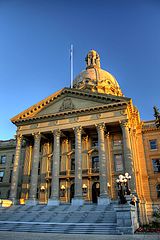
Alberta Legislature Building In December 2011, the Legislative Assembly of Alberta passed the Traffic Safety Amendment Act, 2011 (the “Act”), which increased penalties for impaired drivers in Alberta. These changes were then incorporated into the Alberta Traffic Safety Act, and some of those changes recently came into effect.
In brief, the Act introduced progressive penalties for drivers with blood alcohol concentrations (“BAC”) of .05 or greater; added tougher penalties for drivers with BACs of over .08; and established a stronger zero tolerance policy for new drivers. In many ways, these changes are similar to changes that were introduced in British Columbia a few years ago.
Let’s look at some of the differences in a bit more detail.
Under the old law, Alberta drivers caught with BACs of .05 or greater are subject to a 24-hour suspension. Under the new law (see s.88 of the Traffic Safety Act), starting September 1, 2012 these same drivers would be subject to the following:

  • for first-time offenders, an immediate (i.e. roadside) 3-day licence suspension and a 3 day vehicle seizure;
  • for a second offence, an immediate 15-day licence suspension and a 7-day vehicle seizure, and a mandatory remedial course (for which the driver must pay); and
  • for third (and subsequent) offences, an immediate 30-day suspension and 7-day vehicle seizure for third, a remedial course, and a mandatory review by the Alberta Transportation Safety Board.

Under the old law, Alberta drivers caught with BACs of .08 or greater faced criminal charges and the possibility of having to install a device in their car that tests the driver’s breath and prevents the car from starting if it detects the presence of alcohol (the “ignition interlock”). The installation, removal and rental fee of the ignition interlock had to be paid for by the driver. The requirement for the ignition interlock was discretionary (i.e. it was up to the police to decide if that would or would not be a requirement). Under the new rules, drivers whose BACs are over .08:

  • will continue to face criminal charges;
  • will have their licences immediately suspended until the charges are resolved; and
  • for a first conviction, will require the ignition interlock for 1 year, for a second conviction will require it for 3 years, and for a third conviction will require it for 5 years (all still at the driver’s expense).

Under the old law, new drivers were already required to maintain a BAC of zero. However, now tougher penalties are in place. Graduated drivers who arestopped with any blood alcohol level at all will receive an immediate 30-day licence suspension and 7-day vehicle seizure. In addition, each such 30-day suspension will require one additional year in the Graduated Licence Program.
Drivers who have been accused under these provisions may: request a second roadside breath test; and challenge these penalties by appealing to the Alberta Transportation Safety Board (ATSB) before their criminal trial. However, the license suspension remains in effect during any appeal process.
Although we can likely all agree that driving under the influence is a bad thing (no matter how much we might like MadMen) and that BAC-related motor-vehicle accidents are high, the interesting question here will be whether or not this law will last.
The problem? Well – that pesky constitution of ours again!
Just for fun, let’s take a look at two sections that might come into play.

  • Some might argue that the new rules are “criminal” in nature and that, therefore, the provincial government has no right to pass such laws (criminal laws are in the federal jurisdiction – s.91(27) of the Constitution Act, 1867). This argument was attempted in British Columbia after it passed similar legislation. Although the British Columbia Supreme Court found that the provisions in question were not outside the jurisdiction of the province (see Sivia v British Columbia (Superintendent of Motor Vehicles), “Sivia”), an Alberta court might not make the same finding (as always, the devil is in the details!);
  • Section 11(d) of the Canadian Charter of Rights and Freedoms provides that: “any person charged with an offence has the right […] to be presumed innocent until proven guilty according to law in a fair and public hearing by an independent and impartial tribunal”.  In the original law discussed in Sivia, it was not possible for the results of the roadside screening device to be challenged. That has since been changes, and, as noted above, the Alberta rules do provide for an appeal to the ATSB). However, that appeal could take longer that the suspension itself (especially for first-time offenders). The question therefore, is whether that is enough of an appeal mechanism to satisfy s.11(d) of the Charter. In addition, some might argue that that the indefinite license suspension means that more people will simply plead guilty right away so they can get their license back.

Whoever said the constitution wasn’t interesting?
For more information about the new rules, see the information provided on the Alberta Transportation website.
For more information on the constitutional implications, please see this article by the University of Alberta’s Centre of Constitutional Studies.

Filed Under: Blogosaurus Lex Tagged With: Charter of Rights and Freedoms, constitutional law, drunk driving, Traffic Safety Act

What exactly is a “constitutional exemption”?

July 17, 2012 By Carole (Staff Lawyer)

Scales of JusticeA few days ago, we posted about the BC decision (“the Decision”) that struck down the law against assisted suicide. In that post, we mentioned that Gloria Taylor had obtained a “constitutional exemption.”
So what exactly is a constitutional exemption, and where exactly does a court get the power do that? For that, we have to go back to the Charter and the Constitution Act, 1982.
We start with section 52 of the Constitution Act, 1982, which states that: “[t]he Constitution of Canada is the supreme law of Canada, and any law that is inconsistent with the provisions of the Constitution is, to the extent of the inconsistency, of no force or effect.” This is what helped the court strike down s.241(b) of the Criminal Code in the first place. However, in the Decision, the court went on to say that s.241(b) would continue to have force and effect for one year.  So: s.241(b) is of no force and effect, but, it kind of is, for a year. Clear as mud, right?
This inconsistency then butts up against a different provision of the Charter, namely section 24. Section 24 of the Charter states that: “anyone whose rights or freedoms, as guaranteed by this Charter, have been infringed or denied may apply to a court of competent jurisdiction to obtain such remedy as the court considers appropriate and just in the circumstances.” In other words: if you bring a Charter case and you win, the Court can give you any remedy (i.e.: solution) that fits the case. That could be almost anything, depending on the case. For example: financial compensation, an old job back, or the right to be released from jail.
In this case, given that the law will still have “force and effect” for one year, Ms. Taylor would not be given the remedy she asked for (which, let’s face it, is the only remedy that will make any difference to her). For one whole year, it would still be illegal for a doctor to help her commit suicide. She could still be denied the choice she was seeking at the end of her life.
So – the compromise. We will let Ms. Taylor do it (this is being appealed by the federal government), but no one else (unless they, too, get a constitutional exemption).
Such compromises have been reached in other situations, although many people might not realize that that is what has occurred.
For example: Insite, the Vancouver Safe Injection Site. When Insite was opened in September 2003, it was originally awarded a three-year exemption under section 56 of the Controlled Drugs and Substances Act (CDSA), for scientific and research purposes. This was then temporarily extended a few times. However, the federal government refused to allow Insite to operate past July 2008. As a result, the non-profit society which operated the site brought a court action claiming, amongst many other things, that the drug possession and trafficking provisions of  the CDSA (section 4(1) and 5(1)), as they applied to the Insite location, were unconstitutional, because they violated section 7 of the Charter (which guarantees that “everyone has the right to life, liberty and security of the person”). The argument was essentially as follows:

  • sections 4(1) and 5(1) of the CDSA apply to possession and trafficking for every purpose without discrimination or differentiation;
  • the Insite location is a health care facility with a goal to save lives and treat addiction;
  • because s.4(1) and s.5(1) of the CDSA impose an absolute and unqualified prohibition on controlled substances, it prevents access to this health care facility (i.e.: Insite) that reduces or eliminates the risk of death from an overdose and the risk of infectious disease, by persons who are ill with an addiction, thereby violating the right to life and security of the person;
  • because users of Insite risk incarceration while seeking health care services, the right to liberty is also violated; and
  • because s.56 of the CDSA (which refers to exception for science) should not relied upon as a remedy for a Charter violation.

The judge agreed and declared that s.4(1) was inconsistent with section 7 of the Charter. Naturally, the federal government was given time to rewrite the provisions in order to bring them in line with the Charter, and in the meantime (until June 30, 2009) the law remained in force and effect.  In order to be able to continue its operations during this time, and during the appeals processes, Insite was granted a constitutional exemption. The case went to the Supreme Court of Canada (SCC) in 2011, and now, Insite is back to operating under an exemption of s.56 of CDSA. The reason? The SCC found that sections 4(1) and 5(1) of the CDSA are not unconstitutional (i.e. they are ok and can stand as they are). However, the federal government’s act of denying Insite a continuation of the s.56 exemption was in violation of s.7 of the Charter [see paragraph 156 of the SCC decision].
Interestingly, however, the exact extent of the use of constitutional exemptions has not been clearly defined, and there are those that argue that its legal foundation remains precarious.
As an interesting example: mandatory minimum sentences (“MMS”s) in criminal cases.  The most topical case on this issue is R. v. Ferguson, which was heard by the SCC in 2008. In that case, Michael Ferguson, an RCMP officer, was accused of shooting and killing a detainee during an altercation with that detainee in a cell at an RCMP detachment. At trial, Officer Ferguson was convicted of manslaughter, a crime that carries a four year mandatory minimum sentence pursuant to s. 236(a) of the Criminal Code of Canada. However, Mr. Ferguson argued at trial that a four year sentence violates section 12 of the Charter, which states that “everyone has the right not to be subjected to any cruel and unusual treatment or punishment.” But instead of arguing that s.236(a) should be struck down, he asked for a constitutional exemption (i.e.: the 4 year minimum sentence would continue to apply, just not to him). His reasoning – “the minimum sentence prescribed by Section 236(a) of the Code is grossly disproportionate to the particular circumstances of this case.” The SCC did not agree with him. Amongst many other things, the court found that constitutional exemptions for MMSs intruded on the role of Parliament by granting discretion to sentencing judges that they were not meant to have. This about it: the whole point of MMSs is to take away judges’ discretion to make sentencing decisions based on the circumstances of each individual case: if courts start to grant constitutional exemptions, they are taking back that discretion…something they can only really do if the law in question is generally unconstitutional (which was not argued here).
So… are constitutional exemptions now only available in cases like Ms. Taylor’s? That is, as an interim measure when a claimant requires relief from an unconstitutional law while law-makers examine the options for replacing that law (i.e.: where there has been a “suspended declaration of invalidity” under s. 52 of the constitution)? Hard to say. It will be interesting to see where Canadian law goes with this one.
Fascinating stuff, isn’t it, our constitution!

Filed Under: Blogosaurus Lex Tagged With: assisted suicide, Charter of Rights and Freedoms, constitutional law

Is assisted suicide now legal?

July 13, 2012 By Carole (Staff Lawyer)

Scales of JusticeNot surprisingly, this is a question that we at CPLEA have been asked quite a bit lately.
On June 15th of this year, the British Columbia Supreme Court struck down Canada’s laws against physician-assisted suicide on the basis that it is unconstitutional. In the case in question, Gloria Taylor, a woman suffering from ALS (also known as Lou Gehrig’s disease) asked to be allowed to have a doctor help her commit suicide before she became incapacitated. In making its finding of unconstitutionality, the court also gave Ms. Taylor a constitutional exemption to seek that medical assistance.
So what exactly does all of that mean?
Let’s start with the question of constitutionality. The Canadian Charter of Rights and Freedoms, which is part of the Constitution Act, 1982, protects the people of Canada from certain actions of governmental bodies. More specifically, governments (federal, provincial or municipal) are not allowed to treat people (either through a law or through any other action) in any way that violates the rights and freedoms set out in the Charter. One of these rights (section 15) is the right of every person to be “equal before and under the law” and to have “the right to the equal protection and equal benefit of the law without discrimination” based on various factors. One of these factors is “physical disability”. This is the provision that was applied in this case.
In a nutshell, the reasoning is as follows:

  • suicide itself is not illegal;
  • as a result, able–bodied people are able to commit suicide (i.e. there is no law that stops them from doing so);
  • however, some disabled people are legally prohibited from committing suicide (i.e. those who might need help because they can’t physically do it themselves). The law in question is section 241(b) of the Criminal Code of Canada (“s.241(b)”);
  • as a result, disabled people are not equal under the law (i.e. the law specifically prohibits them from doing what able-bodied people can);
  • under section 15 of the Charter, that in equality that is not allowed.

The result: s.241(b), the law that says that it is a crime to help someone commit suicide, is unconstitutional and is therefore, “struck down”. What that essentially means is that it is as if s.241(b) is simply crossed off the books – it is as if it does not exist.
So that means the terminally ill can all ask doctors for help, right? Wrong.
Often, when a law is declared unconstitutional, the court has to give the government some time to deal with that fact. Think about all the systems in place, all the official literature on the topic, websites etc. It takes time to prepare for changes in law. Not to mention, the court needs to give the government time to appeal the decision, if it so chooses (and this one already has been). Imagine the back and forth and back forth that could happen throughout the appeal process if law kept being struck down, and maybe reinstated, and struck down again…etc, etc. In this case, the government was given one year to get its affairs in order. For that year, the law remains in effect.
However, leaving it at that would not help Ms. Taylor very much. Not letting her decide her own time of death after she had won her case would not make much sense. As a result, the court granted Ms. Taylor a “constitutional exemption.” This is for her and her alone. In other words, it allows the law to remain in effect (for the one year, as planned), but gives Ms. Taylor the remedy she was seeking. In other words, Ms. Taylor is now free to find a doctor to help her commit suicide (for now anyway, but that is being appealed too). If she does, and that doctor does so during the year that the law technically remains in effect, that doctor will be exempt from prosecution under s.241(b) of the Criminal Code.
So the answer is: no, assisted suicide is not yet legal…unless you are Ms. Taylor.
If you want to read the whole BC decision, it can be found here.

Filed Under: Blogosaurus Lex Tagged With: assisted suicide, Charter of Rights and Freedoms, constitutional law

One for the people: The 1929 Persons Case

October 18, 2011 By Margo (Associate Director)

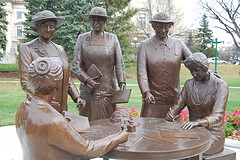
The Famous Five
Famous Five Monument – Manitoba Legislative Building. Photo by AdolfGalland

October 18th is the anniversary of the Persons Case, when five Alberta women won their fight to have women declared “persons” under the law. The battle stemmed from an 1867 common law ruling that “Women are persons in matters of pains and penalties, but are not persons in matters of rights and privileges.”
With her sights set on a Senate seat, Emily Murphy joined forces with four other like-minded women, Irene Parlby, Nellie McClung, Louise McKinney and Henrietta Muir Edwards, to appeal to the Supreme Court of Canada for clarification of the definition of the word ‘person’ as it appeared in the British North America Act.
Sections 23 and 24 of the British North America Act (now referred to as the Constitution Act, 1867) defined the qualifications for the Senate. The British North America Act used the words ‘he’ and ‘him’ when referring to individuals and ‘persons’ when referring to more than one individual.  The Supreme Court of Canada took the position that in 1867, the year the  British North America Act came into force, the use of the words ‘he’, ‘him’ and ‘persons’ would have been interpreted as referring only to men thus ruling women ineligible as persons qualified for appointment to the Senate and other matters of politics and affairs of state (See Edwards v. Canada (Attorney General) [1928] S.C.R. 276.).
The women, by then known as the “Famous Five”, appealed to what was then the highest Court in Canada, the Judicial Committee of the Privy Council. On October 18, 1929 Lord Sankey delivered the Council’s decision in favour of the women. In his announcement, the Lord Chancellor stated that the British North America Act planted in Canada was “a living tree capable of growth and expansion within its natural limits” (See Edwards v. A.G. of Canada [1930] A.C. 124.).  He also noted: “that the exclusion of women from all public offices is a relic of days more barbarous than ours. And to those who would ask why the word “person” should include females, the obvious answer is, why should it not?” As a result, the Council concluded that, “the word ‘persons’ in Sec. 24 includes members both of the male and female sex… and that women are eligible to be summoned to and become members of the Senate of Canada.”
The Persons Case represented a significant step forward for women’s rights in Canada. On February 14, 1930, Mrs. Cairine MacKay Wilson became Canada’s first woman Senator.  Today, there are 37 women in the Senate, representing approximately one-third of the current 105 seats.
Since 1979, outstanding individuals who have helped to advance equality for women in Canada have been recognized by means of the Governor General’s Awards in Commemoration of the Persons Case. This year six individuals have been named as recipients of this Award. The Right Honourable David Johnston, Governor General of Canada will present the Awards during a ceremony at Rideau Hall on Persons Day, October 18, 2011.
For more information on the Persons Case and its historical significance:
Herstory: An Exhibition. (1998). Law: The “Persons” Case: http://library.usask.ca/herstory/person.html
Hughes, V. (2001/2). How the Famous Five in Canada Won Personhood for Women . London Journal of Canadian Studies, 17: http://www.canadian-studies.net/lccs/LJCS/Vol_17/index.html
Library and Archives Canada. (2008). Famous Five: http://epe.lac-bac.gc.ca/100/206/301/lac-bac/famous_five-ef/www.lac-bac.gc.ca/famous5/index-e.html
Section15.ca. (2004). Persons Case: http://section15.ca/features/ideas/2004/12/22/persons_case/

(Photo: http://www.flickr.com/photos/35477558@N04/5069199377/)


Filed Under: Blogosaurus Lex Tagged With: constitutional law, Edwards v. Canada, Famous Five, human rights, legal history, legal reform, Supreme Court of Canada, women

  • « Previous Page
  • 1
  • 2

What’s New

Get up-to-date on the latest news and upcoming events at CPLEA

Sign up for our monthly newsletter!

Order Free Print Copies

Every year we send out thousands of free printed resources about the law in Alberta.

Just ask, and we'll do the printing for you!

Order Free Print Copies of our Legal Resources

Territory Acknowledgement

The Centre for Public Legal Education respectfully acknowledges that we are located across Treaty 4, 6, 7, 8 and 10 territories, and respects the histories, languages, and cultures of First Nations, Métis, Inuit, and all First Peoples of Canada, whose presence continues to enrich our vibrant community.

Funders & Partners

alf-logo_tn
sof-logo_tn
sof-logo_tn
Terms of Use