CPLEA.CA

  • Contact
  • About
    • Board of Directors
    • Work with CPLEA
    • Funders
    • Staff
    • Volunteers
  • Our Work
    • Justice Navigator Training
    • Websites
    • What’s New
    • Workshops
  • Legal Topics
    • Abuse & Protection
    • Condominium Law
    • Consumer, Money and Debt
    • Family & Relationships
    • Housing
    • Planning for Future Care
    • Resolving Disputes
    • Recreation
    • Ressources en français
    • Wills & Estates
    • Work
Home / Archives for Supreme Court of Canada

LawNow 39-6: The Top Court, Self-Represented Litigants

June 30, 2015 By CPLEAadmin

the-top-court
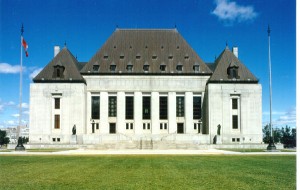
Canada’s top court is a cornerstone of our Parliamentary democracy and the Rule of Law.  It has shaped our nation since 1875.

Volume 39-6 – July/August 2015

Table of Contents


Featured Articles: The Top Court
Special Report: Self Represented-Litigants
Columns

Featured Articles: The Top Court

Democratic Governance: The Constitution and Canada’s Branches of Government
Lorraine Snyder and Dustin Martin
In order to understand the role of Canada’s top court, it is necessary to understand how it fits within our Constitution.

The Supreme Court of Canada: A History
Hugo Vaillancourt
Canada’s top court has seen many changes since it was first created in 1875.

Judicial Review is Different from Judicial Activism
Charles Davison
Our judges have a duty to review the legitimacy of laws and strike them down if they are contrary to the Constitution.
The Nadon Reference: A Unique Challenge
John Edmond
The recent Reference re Supreme Court Act concerning nominated Justice Marc Nadon was unprecedented in Canadian judicial history.
Top Courts in the U.S. and Canada: A Comparison
Peter Bowal and Jacqueline Bowal

Our top courts reflect each country’s cultural and political differences as our comprehensive chart outlines.

Special Report: Self-Represented Litigants

What Self–Represented Litigants (Actually) Want
Sarah Burton
Here’s a novel idea:  why don’t we ask self-represented litigants what would actually help them!
Small Claims Court: A Venue Made for Self-Represented Litigants
Peter Bowal and Jacqueline Bowal
This court is specifically set up to assist people who want to represent themselves.
The Vexatious Litigant
Trevor Todd and Judith Milliken, QC
Sometimes, self-represented litigants can abuse or misuse the court system so that sanctions are necessary.

Columns

Family Law
Sarah Dargatz
Financial Disclosure in Family Law Cases, Don’t Hide; It’s Best to Provide!
Human Rights Law
Linda McKay-Panos
Supreme Court of Canada Addresses Jury Composition and Aboriginal Equality
Employment Law
Peter Bowal
Politician Resignations and Personal Liability for By-Election Costs
Online Law
Marilyn Doyle
Going it alone? Resources for Self-Represented Litigants
Not-For-Profit Law
Peter Broder
The Purposes and Activities Divide in Charity Regulation
Law & Literature
Rob Normey
John Lennon: Working Class Hero and Legal Activist
A Famous Case Revisited
Peter Bowal and Pedro Porto Alegre
Whatever Happened To…Antrim Truck Ltd. and Public Nuisances


Filed Under: Blogosaurus Lex Tagged With: constitutional law, LawNow, LawNow Magazine, Self-represented litigants, Supreme Court of Canada, The Charter

LawNow 38-6 Bench Marks: Cases that Change the Legal Landscape

July 14, 2014 By CPLEAadmin

Bench Marks: Cases that Change the Legal Landscape

Featured Articles: Bench Marks: Cases that Change the Legal Landscape


Some decisions our courts make carry the possibility of changing lives (same-sex marriage) and defining our institutions (the Senate).  This issue looks at a few of these “Bench Marks”.
Landmark Cases: Cases which have changed the Legal and Social Landscape of Canada
Some cases have had the effect of changing not only the legal but also the social landscape of Canada. Here is a look at a few of them.
The Increasing Importance of Reference Decisions in Canadian Law
Reference Decisions, from the Senate Question to the Nadon decision, are increasingly important in Canadian jurisprudence.
Supreme Court Reins in Social Credit
This 1938 case has echoed through history with its powerful support for freedom of expression and freedom of the press as necessary aspects of our constitutional democracy.
The Whatcott Case: Balancing Free Speech and Social Harmony
The Whatcott decision highlights the clash of Charter values when evaluating hate speech.

Special Report: Aboriginal Law


Indian Residential Schools: A Chronology
From 1755 to 2014: a timeline of the Residential Schools tragedy.
The Indian Act – Exemption from Taxation
Interpretations and court decisions have shaped the income tax rules for Canada’s aboriginal people.
Aboriginal Children and Child Welfare Policies
The Residential Schools program scarred generations of aboriginal children. Today, child welfare policies have the potential to cause damage too.

Departments


Viewpoint
A Bench Mark case indeed!
Ask a Law Librarian
Researching Aboriginal Law

Columns


Human Rights Law
Human Rights of Transgender Persons
Not-for-Profit Law
New Legislation Eases Moves Into or Out of Alberta for Not-For-Profits
Employment Law
Compassionate Care: A New Basis for Temporary Unpaid Leave from Work
Landlord and Tenant Law
Can a landlord charge a tenant for renovations?
Family Law
Protection Orders in Dangerous Circumstances
A Famous Case Revisited
Whatever Happened to … Childs v. Desormeaux: Killer Hospitality

Filed Under: Blogosaurus Lex Tagged With: Aboriginal Law, Benchmark Cases, constitutional law, LawNow, Reference Decisions, residential schools, Supreme Court of Canada, The Charter

What on earth does the Budget have to do with the Constitution?

March 21, 2014 By Carole (Staff Lawyer)

Supreme Court of CanadaIn the federal omnibus budget released last fall Marc Nadon was appointed to the Supreme Court of Canada. Today, we learned from the Supreme Court of Canada (SCC) that, due to the Canadian Constitution, that appointment will not stand. What could the one have to do with the other I hear you ask? Let’s explore!
The Constitution of Canada (which is actually not one document, but several, but we will just use it as a group noun)* is often referred to as the “highest law” in the land.  As such, it has quite a few roles. The one that matters for today is the role it plays a form of “umbrella” legislation that governs all governmental actors and actions in Canada. What does that mean? Well, in a nutshell, everything that any government in Canada does (be it federal, provincial or municipal government), must not contradict what the Constitution says. One of the actions a government can take is passing laws, such as a budget. As a result, everything in that budget has to be in line with everything in the Constitution.
According to the SCC the appointment of Marc Nadon, which was in that budget, contradicted the Constitution. How?
Let’s start with looking at the make-up of the 9-judge court. Due to the nature of the creation of the country, SCC position have always been divided in such a way as to address the concern for representation from all regions and legal systems:  3 from Québec, 3 from Ontario, 2 from the West, 1 from the East.  The empty position, in this case, was one of the seats from Québec. As a result, the appointment process had to follow the rules from appointments from Québec.
The Supreme Court Act (SCA, which is a federal law) tells us what that appointment process is. Specifically,  sections 5 and 6  state that Québec appointees must either come from the Québec Superior Court, the Québec Court of Appeal, or must be a current member of the Québec bar (and must have been so for at least 10 years).
Here’s where the problems start. At the time of his appointment, Marc Nadon was no longer a member the Québec bar: he used to be, but he’s not anymore. Similarly, he was not a judge from the Québec Superior Court, or the Québec Court of Appeal (he was on the Federal Court of Appeal – which is completely different).
To try to address Naton’s apparent ineligibility, the budget included an amendment to the SCA that would allow “former” members of the Québec bar to be appointed .
So why did that not suffice? And what does that have to do with the Constitution?
Well, by putting all of this in the budget, the federal government was acting on its own. In other words,  it was acting “unilaterally”. Often, when passing laws, this is not a problem. However, it was here, as the essential make-up of the SCC is protected by the Constitution Act 1982 (CA 1982). Specifically, section 41(d) of CA 1982 requires that any changes to the composition of the SCC must receive unanimous consent from both the Parliament of Canada and the legislatures of all of the provinces. In this case, the parliament was on board, but none of the provinces had given their official approval.
Oh that Constitution… it’s everywhere!
As an aside, the story may not yet be complete. At paragraph 71 of its decision, the SCC said:
“We note in passing that the reference questions do not ask whether a judge of the Federal Court or Federal Court of Appeal who was a former advocate of at least 10 years standing at the Québec bar could rejoin the Québec bar for a day in order to be eligible for appointment to this Court under Sec. 6. We therefore do not decide this issue.”
Anyone want to take bets on happens next?
* For example: the Constitution Act 1867, the Constitution Act 1982, and a few others.


Filed Under: Blogosaurus Lex Tagged With: constitutional law, Supreme Court of Canada

The Supreme Court of Canada and the Case of Baby M

September 21, 2012 By Carole (Staff Lawyer)

Supreme Court of CanadaIn school, we learn that the Supreme Court of Canada (SCC) is the ‘highest court’ in the land (and has been since 1949). We learn that lower court decisions can be “appealed” to the SCC, and we hear about all kinds of important decisions coming from the Court. But, for most of us, the exact process of getting to the SCC, and whether that is even possible, is a bit of mystery. Add to that the influence from television crime shows, which seem to imply that anything and everything can and should be appealed …. and it is no surprise that most of us a little fuzzy on the issue of appeals.
Yesterday, in Edmonton, the question of appeals to the SCC formed part of the most talked-about story of the day: Baby M. In that case, the Alberta Court of Appeal had decided that M should be taken off of life support. M’s parents asked the SCC to stay that decision (i.e.: keep M on life support) in order to give them time to apply to appeal the case to the SCC. The SCC refused.
So what does all of that mean?
Most cases come before the SCC in a formalized procedure, beginning with a judgment at trial, which is then appealed to a Court of Appeal. If the litigants are of the opinion that a mistake was made at the appeal level, then one or both may ask for ‘leave to appeal’ the matter to the SCC. This happens about 600 per year. This process of leave is a surprise to many people, who sometimes think that there is an automatic ‘right’ to appeal to the SCC. There isn’t (except for a few exceptions). And leave is not that easy to get: the SCC only grants it about 80 times per year.
During the leave process, a panel of SCC judges (usually 3) does a little mini-analysis to decide if it should even hear the appeal (so it a 2-step process). More specifically, the SCC applies the criteria found in the Supreme Court Act, which states that an application for leave to appeal may be granted if the case:

  • raises an issue of public importance (in other words, the case must raise an issue that goes beyond the immediate interests of the parties to the case); and
  • should be decided by the Supreme Court of Canada.

But surely the Baby M case is of public importance?
Well, yes. But the SCC can refuse leave if it feels that the law in question, as socially important as it may be, has already been decided (especially if it was previously examined by the SCC itself) and there is nothing else to say on the issue. Sometimes, however, even though the SCC has already made a decision about the topic in question, it will nonetheless grant leave. This can occur, for example, when the SCC feels that the fabric of society has significantly changed since it last gave a decision on the issue.
In this case, we were not yet at the “leave” stage per se. The court was being asked for a stay in order to give baby M’s parents’ time to apply for leave to have the case heard at the SCC. But, since the stay was denied, and Baby M died, there will now no longer be a case to hear, and no need to apply for leave.
Although individual Canadians may disagree on the outcome, I think that, as a group, we can all agree that it was both inspiring and comforting and to see the speed and thoughtfulness with which our court system responded in the case.
May Baby M rest in peace.


Filed Under: Blogosaurus Lex Tagged With: case law, Court of Appeal, Supreme Court of Canada

Teachers Talk LawNow – Jim Keegstra

August 27, 2012 By CPLEAadmin

LawNow magazine is an incredible resource for teachers. Each issue offers engaging articles about law in language suitable for students. Teachers Talk LawNow is a series of lesson plans for teachers based on these articles. 
Jim Keegstra

“R. v. Keegstra was such a landmark freedom of expression case that aspects of this issue were considered in three separate trips to the Supreme Court of Canada between 1990 and 1996.”

This LawNow article is available to download in the July/August 2012 issue of LawNow magazine :

  • What Ever Happened to … Jim Keegstra – Peter Bowal and Craig Graham

This weeks blog shifts out of the classroom and into the staff room. Jim Keegstra was a teacher from Eckville, Alberta. For years he had been teaching students his own brand of history that included Jewish conspiracies and other anti-Semitic content. Eventually he was charged with criminally promoting hatred against an identifiable group.

Many recently graduated teachers studied this case in University and older teachers will remember the news coverage. Leave this article on a coffee table in the staff room and see what discussions it creates. Some discussion points to get your started are:

  • How could Keegstra teach his opinions for so long and could something like this happen today?
  • What limits should there be on “free speech”?
  • If Keegstra had kept his opinions out of the classroom, but still made them public, should he have kept his job?

Filed Under: Blogosaurus Lex Tagged With: LawCentral Schools, LawNow, Supreme Court of Canada, Teachers Talk LawNow, Youth

One for the people: The 1929 Persons Case

October 18, 2011 By Margo (Associate Director)

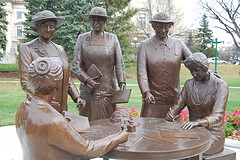
The Famous Five
Famous Five Monument – Manitoba Legislative Building. Photo by AdolfGalland

October 18th is the anniversary of the Persons Case, when five Alberta women won their fight to have women declared “persons” under the law. The battle stemmed from an 1867 common law ruling that “Women are persons in matters of pains and penalties, but are not persons in matters of rights and privileges.”
With her sights set on a Senate seat, Emily Murphy joined forces with four other like-minded women, Irene Parlby, Nellie McClung, Louise McKinney and Henrietta Muir Edwards, to appeal to the Supreme Court of Canada for clarification of the definition of the word ‘person’ as it appeared in the British North America Act.
Sections 23 and 24 of the British North America Act (now referred to as the Constitution Act, 1867) defined the qualifications for the Senate. The British North America Act used the words ‘he’ and ‘him’ when referring to individuals and ‘persons’ when referring to more than one individual.  The Supreme Court of Canada took the position that in 1867, the year the  British North America Act came into force, the use of the words ‘he’, ‘him’ and ‘persons’ would have been interpreted as referring only to men thus ruling women ineligible as persons qualified for appointment to the Senate and other matters of politics and affairs of state (See Edwards v. Canada (Attorney General) [1928] S.C.R. 276.).
The women, by then known as the “Famous Five”, appealed to what was then the highest Court in Canada, the Judicial Committee of the Privy Council. On October 18, 1929 Lord Sankey delivered the Council’s decision in favour of the women. In his announcement, the Lord Chancellor stated that the British North America Act planted in Canada was “a living tree capable of growth and expansion within its natural limits” (See Edwards v. A.G. of Canada [1930] A.C. 124.).  He also noted: “that the exclusion of women from all public offices is a relic of days more barbarous than ours. And to those who would ask why the word “person” should include females, the obvious answer is, why should it not?” As a result, the Council concluded that, “the word ‘persons’ in Sec. 24 includes members both of the male and female sex… and that women are eligible to be summoned to and become members of the Senate of Canada.”
The Persons Case represented a significant step forward for women’s rights in Canada. On February 14, 1930, Mrs. Cairine MacKay Wilson became Canada’s first woman Senator.  Today, there are 37 women in the Senate, representing approximately one-third of the current 105 seats.
Since 1979, outstanding individuals who have helped to advance equality for women in Canada have been recognized by means of the Governor General’s Awards in Commemoration of the Persons Case. This year six individuals have been named as recipients of this Award. The Right Honourable David Johnston, Governor General of Canada will present the Awards during a ceremony at Rideau Hall on Persons Day, October 18, 2011.
For more information on the Persons Case and its historical significance:
Herstory: An Exhibition. (1998). Law: The “Persons” Case: http://library.usask.ca/herstory/person.html
Hughes, V. (2001/2). How the Famous Five in Canada Won Personhood for Women . London Journal of Canadian Studies, 17: http://www.canadian-studies.net/lccs/LJCS/Vol_17/index.html
Library and Archives Canada. (2008). Famous Five: http://epe.lac-bac.gc.ca/100/206/301/lac-bac/famous_five-ef/www.lac-bac.gc.ca/famous5/index-e.html
Section15.ca. (2004). Persons Case: http://section15.ca/features/ideas/2004/12/22/persons_case/

(Photo: http://www.flickr.com/photos/35477558@N04/5069199377/)


Filed Under: Blogosaurus Lex Tagged With: constitutional law, Edwards v. Canada, Famous Five, human rights, legal history, legal reform, Supreme Court of Canada, women

Today's Trial: R. v. Tran

February 3, 2011 By Teresa (Editor, LawNow)

The Supreme Court of Canada had an opportunity last November to hear the appeal of a tragic case of murder that occurred in Edmonton in 2004.  Its judgment combined two worlds: facts that could have been lifted from a 20thcentury soap opera, with legal history dating back to the 1500s. Its decision encapsulates 21st century Canadian notions of honour and reason.
An Edmonton man, Thieu Kham Tran, was estranged from his wife.   He knew that she was seeing another man, so one afternoon he let himself into her locked apartment with keys that she didn’t know he still possessed. There, he discovered her in bed with her boyfriend.  In a frenzy of anger, he repeatedly stabbed them both, killing the boyfriend.  At trial, Mr. Tran used the defence of provocation against a charge of murder, arguing that he lost all self-control after witnessing the sight of his wife in bed with another man.
Provocation as a defence can only be used in cases of murder. It is a partial defence only, to be used to reduce a conviction from murder to manslaughter. In Mr. Tran’s case the trial judge accepted his argument of provocation and convicted him of the lesser offence of manslaughter.  The Crown appealed, and the Alberta Court of Appeal set aside that verdict and substituted a conviction for second-degree murder.  Mr. Tran appealed that decision, and the case went to the Supreme Court of Canada.
The issues before the Supreme Court were the legal principles and requirements for the defence of provocation.  Madame Justice Marie Charron wrote the unanimous decision.
For students of legal history, the judgment makes interesting reading.  The Court reviewed the development of the defence of provocation in English common law, beginning in the sixteenth century.  It was originally called chancemedley, meaning “done by chance upon a sudden brawle, shuffling or contention.”  In the seventeenth century, English courts created a separate offence of manslaughter, as a response to the severity of the death penalty for murder.  This separate offence was meant to take human frailty into account, and one such concession to human frailty was provocation. In the eighteenth century, the defence of provocation became more fully developed, with judges creating specific categories of provocative events, considered significant enough to cause a person to lose control.  One such case was that of a husband catching a man in the act of adultery with his wife, wherein the judge wrote: “jealousy is the rage of a man, and adultery is the highest invasion of property.”
The defence of provocation came to this country in 1892 when it was adopted and codified in the Criminal Code of Canada. Section 232 remains more or less the same to this day:  “Culpable homicide that otherwise would be murder may be reduced to manslaughter if the person who committed it did so in the heat of passion caused by sudden provocation.”
R. v. Tran http://scc.lexum.umontreal.ca/en/2010/2010scc58/2010scc58.html
[Read more…]

Filed Under: Blogosaurus Lex Tagged With: LawNow, Supreme Court of Canada, Today's Trial

What’s New

Get up-to-date on the latest news and upcoming events at CPLEA

Sign up for our monthly newsletter!

Order Free Print Copies

Every year we send out thousands of free printed resources about the law in Alberta.

Just ask, and we'll do the printing for you!

Order Free Print Copies of our Legal Resources

Territory Acknowledgement

The Centre for Public Legal Education respectfully acknowledges that we are located across Treaty 4, 6, 7, 8 and 10 territories, and respects the histories, languages, and cultures of First Nations, Métis, Inuit, and all First Peoples of Canada, whose presence continues to enrich our vibrant community.

Funders & Partners

alf-logo_tn
sof-logo_tn
sof-logo_tn
Terms of Use