CPLEA.CA

  • Contact
  • About
    • Board of Directors
    • Work with CPLEA
    • Funders
    • Staff
    • Volunteers
  • Our Work
    • Justice Navigator Training
    • Websites
    • What’s New
    • Workshops
  • Legal Topics
    • Abuse & Protection
    • Condominium Law
    • Consumer, Money and Debt
    • Family & Relationships
    • Housing
    • Planning for Future Care
    • Resolving Disputes
    • Recreation
    • Ressources en français
    • Wills & Estates
    • Work
Home / Archives for Blogosaurus Lex

The Supreme Court of Canada and the Case of Baby M

September 21, 2012 By Carole (Staff Lawyer)

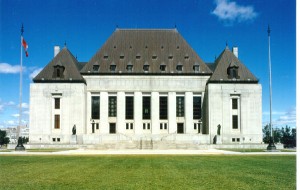
Supreme Court of CanadaIn school, we learn that the Supreme Court of Canada (SCC) is the ‘highest court’ in the land (and has been since 1949). We learn that lower court decisions can be “appealed” to the SCC, and we hear about all kinds of important decisions coming from the Court. But, for most of us, the exact process of getting to the SCC, and whether that is even possible, is a bit of mystery. Add to that the influence from television crime shows, which seem to imply that anything and everything can and should be appealed …. and it is no surprise that most of us a little fuzzy on the issue of appeals.
Yesterday, in Edmonton, the question of appeals to the SCC formed part of the most talked-about story of the day: Baby M. In that case, the Alberta Court of Appeal had decided that M should be taken off of life support. M’s parents asked the SCC to stay that decision (i.e.: keep M on life support) in order to give them time to apply to appeal the case to the SCC. The SCC refused.
So what does all of that mean?
Most cases come before the SCC in a formalized procedure, beginning with a judgment at trial, which is then appealed to a Court of Appeal. If the litigants are of the opinion that a mistake was made at the appeal level, then one or both may ask for ‘leave to appeal’ the matter to the SCC. This happens about 600 per year. This process of leave is a surprise to many people, who sometimes think that there is an automatic ‘right’ to appeal to the SCC. There isn’t (except for a few exceptions). And leave is not that easy to get: the SCC only grants it about 80 times per year.
During the leave process, a panel of SCC judges (usually 3) does a little mini-analysis to decide if it should even hear the appeal (so it a 2-step process). More specifically, the SCC applies the criteria found in the Supreme Court Act, which states that an application for leave to appeal may be granted if the case:

  • raises an issue of public importance (in other words, the case must raise an issue that goes beyond the immediate interests of the parties to the case); and
  • should be decided by the Supreme Court of Canada.

But surely the Baby M case is of public importance?
Well, yes. But the SCC can refuse leave if it feels that the law in question, as socially important as it may be, has already been decided (especially if it was previously examined by the SCC itself) and there is nothing else to say on the issue. Sometimes, however, even though the SCC has already made a decision about the topic in question, it will nonetheless grant leave. This can occur, for example, when the SCC feels that the fabric of society has significantly changed since it last gave a decision on the issue.
In this case, we were not yet at the “leave” stage per se. The court was being asked for a stay in order to give baby M’s parents’ time to apply for leave to have the case heard at the SCC. But, since the stay was denied, and Baby M died, there will now no longer be a case to hear, and no need to apply for leave.
Although individual Canadians may disagree on the outcome, I think that, as a group, we can all agree that it was both inspiring and comforting and to see the speed and thoughtfulness with which our court system responded in the case.
May Baby M rest in peace.



Filed Under: Blogosaurus Lex Tagged With: case law, Court of Appeal, Supreme Court of Canada

Legal help for low income Calgary seniors

August 30, 2012 By Margo (Associate Director)

Calgary Legal GuidanceDo you know a Calgary-based older adult who may be in need of legal information and advice but can’t afford it?
A valuable new service has been announced by Calgary Legal Guidance.
FREE Legal Advice for Older Adults – 65+ Low Income
Those who qualify can obtain legal information, assistance, or advice regarding any of the following:

  •  Personal Directives
  •  Powers of Attorney
  •  Supportive Housing
  •  Long Term Care
  •  Health Care Treatment
  •  Control over Finances
  •  Guardianship and Trusteeship
  •  Capacity

Call (403) 234-9266 for an appointment to meet with a lawyer. Available each Tuesday morning at Calgary Legal Guidance.

Filed Under: Blogosaurus Lex Tagged With: Calgary Legal Guidance, Legal Advice, Legal Information, Seniors

Changes to citizen's arrest

July 31, 2012 By Carole (Staff Lawyer)

handcuffsOn June 28, 2012 the federal government gave royal assent to a new law that expands the power for ordinary Canadians to make a citizen’s arrest, and that streamlines the provisions regarding defending oneself and one’s property.

So what exactly are these changes, and what do they mean for the average Canadian?
The new law, Bill C-26 (also known as the “Lucky Moose Bill” – more on that later) amends s.494 of the Criminal Code of Canada. Under the old law, ordinary citizens could only arrest someone if they found a person actually committing a criminal offence. This requirement for the offender to be caught red-handed is what had been the stumbling block in a widely-publicized 2009 case out of Toronto. In that case, David Chen, the owner of the Lucky Moose Food Mart (there’s the link!) spotted a man coming towards his store and recognized him as having previously stolen some plants. Chen and two employees chased the accused, caught up to him a short distance away, grabbed him, tied him up, and threw him into their delivery van so that they could hold him until the police came.  Instead of being hailed as heroes, however, Mr. Chen and his employees found themselves arrested and charged with assault and forcible confinement (they were ultimately acquitted, although only after first refusing a plea bargain that sought to have them admit to lesser charges).
Under the new law, Mr. Chen would likely fare better. The new law allows citizen’s arrests not only while the offence is being committed, but within a “reasonable time” after the offence if the citizen making the arrest believes “on reasonable grounds” that it is “not feasible” for police to make the arrest. In short: there will now be more latitude in the manner and timing of making citizen’s arrests, as long as the actions in question are seen by the courts as being “reasonable” under the circumstances. However, law enforcement must still be contacted as soon as possible afterwards.
The new legislation also pulls together a number of Criminal Code provisions that dealt with the defence of personal property. More specifically, the new law allows those who are in “peaceful possession” of property to take reasonable steps to protect that property from persons entering the property when they are not allowed to do so, or from stealing or damaging that property. Again, the actions taken must have been reasonable in the circumstances.
The next question that arises is, naturally, what does “reasonable” in the circumstance mean? Although there is no definite answer to that question, the new law does set out a list of factors which the court may take into account in determining what is reasonable. These factors include: the nature of the force or threat; whether weapons were involved, whether the threat was imminent; the role of all parties involved in the incident; the prior relationship of all the parties if any; the age, size and gender of the parties; and the proportionality of the response.
The result: this is not a carte blanche for vigilantism, but, hopefully, it will help make us all safer and result in fewer victims finding themselves facing criminal charges.
Remember, though: keep it reasonable!
For information regarding the reasoning behind the new law, see the legislative summary.

Filed Under: Blogosaurus Lex Tagged With: citizen's arrest, Criminal Code of Canada

What exactly is a “constitutional exemption”?

July 17, 2012 By Carole (Staff Lawyer)

Scales of JusticeA few days ago, we posted about the BC decision (“the Decision”) that struck down the law against assisted suicide. In that post, we mentioned that Gloria Taylor had obtained a “constitutional exemption.”


So what exactly is a constitutional exemption, and where exactly does a court get the power do that? For that, we have to go back to the Charter and the Constitution Act, 1982.
We start with section 52 of the Constitution Act, 1982, which states that: “[t]he Constitution of Canada is the supreme law of Canada, and any law that is inconsistent with the provisions of the Constitution is, to the extent of the inconsistency, of no force or effect.” This is what helped the court strike down s.241(b) of the Criminal Code in the first place. However, in the Decision, the court went on to say that s.241(b) would continue to have force and effect for one year.  So: s.241(b) is of no force and effect, but, it kind of is, for a year. Clear as mud, right?
This inconsistency then butts up against a different provision of the Charter, namely section 24. Section 24 of the Charter states that: “anyone whose rights or freedoms, as guaranteed by this Charter, have been infringed or denied may apply to a court of competent jurisdiction to obtain such remedy as the court considers appropriate and just in the circumstances.” In other words: if you bring a Charter case and you win, the Court can give you any remedy (i.e.: solution) that fits the case. That could be almost anything, depending on the case. For example: financial compensation, an old job back, or the right to be released from jail.
In this case, given that the law will still have “force and effect” for one year, Ms. Taylor would not be given the remedy she asked for (which, let’s face it, is the only remedy that will make any difference to her). For one whole year, it would still be illegal for a doctor to help her commit suicide. She could still be denied the choice she was seeking at the end of her life.
So – the compromise. We will let Ms. Taylor do it (this is being appealed by the federal government), but no one else (unless they, too, get a constitutional exemption).
Such compromises have been reached in other situations, although many people might not realize that that is what has occurred.
For example: Insite, the Vancouver Safe Injection Site. When Insite was opened in September 2003, it was originally awarded a three-year exemption under section 56 of the Controlled Drugs and Substances Act (CDSA), for scientific and research purposes. This was then temporarily extended a few times. However, the federal government refused to allow Insite to operate past July 2008. As a result, the non-profit society which operated the site brought a court action claiming, amongst many other things, that the drug possession and trafficking provisions of  the CDSA (section 4(1) and 5(1)), as they applied to the Insite location, were unconstitutional, because they violated section 7 of the Charter (which guarantees that “everyone has the right to life, liberty and security of the person”). The argument was essentially as follows:

  • sections 4(1) and 5(1) of the CDSA apply to possession and trafficking for every purpose without discrimination or differentiation;
  • the Insite location is a health care facility with a goal to save lives and treat addiction;
  • because s.4(1) and s.5(1) of the CDSA impose an absolute and unqualified prohibition on controlled substances, it prevents access to this health care facility (i.e.: Insite) that reduces or eliminates the risk of death from an overdose and the risk of infectious disease, by persons who are ill with an addiction, thereby violating the right to life and security of the person;
  • because users of Insite risk incarceration while seeking health care services, the right to liberty is also violated; and
  • because s.56 of the CDSA (which refers to exception for science) should not relied upon as a remedy for a Charter violation.

The judge agreed and declared that s.4(1) was inconsistent with section 7 of the Charter. Naturally, the federal government was given time to rewrite the provisions in order to bring them in line with the Charter, and in the meantime (until June 30, 2009) the law remained in force and effect.  In order to be able to continue its operations during this time, and during the appeals processes, Insite was granted a constitutional exemption. The case went to the Supreme Court of Canada (SCC) in 2011, and now, Insite is back to operating under an exemption of s.56 of CDSA. The reason? The SCC found that sections 4(1) and 5(1) of the CDSA are not unconstitutional (i.e. they are ok and can stand as they are). However, the federal government’s act of denying Insite a continuation of the s.56 exemption was in violation of s.7 of the Charter [see paragraph 156 of the SCC decision].
Interestingly, however, the exact extent of the use of constitutional exemptions has not been clearly defined, and there are those that argue that its legal foundation remains precarious.
As an interesting example: mandatory minimum sentences (“MMS”s) in criminal cases.  The most topical case on this issue is R. v. Ferguson, which was heard by the SCC in 2008. In that case, Michael Ferguson, an RCMP officer, was accused of shooting and killing a detainee during an altercation with that detainee in a cell at an RCMP detachment. At trial, Officer Ferguson was convicted of manslaughter, a crime that carries a four year mandatory minimum sentence pursuant to s. 236(a) of the Criminal Code of Canada. However, Mr. Ferguson argued at trial that a four year sentence violates section 12 of the Charter, which states that “everyone has the right not to be subjected to any cruel and unusual treatment or punishment.” But instead of arguing that s.236(a) should be struck down, he asked for a constitutional exemption (i.e.: the 4 year minimum sentence would continue to apply, just not to him). His reasoning – “the minimum sentence prescribed by Section 236(a) of the Code is grossly disproportionate to the particular circumstances of this case.” The SCC did not agree with him. Amongst many other things, the court found that constitutional exemptions for MMSs intruded on the role of Parliament by granting discretion to sentencing judges that they were not meant to have. This about it: the whole point of MMSs is to take away judges’ discretion to make sentencing decisions based on the circumstances of each individual case: if courts start to grant constitutional exemptions, they are taking back that discretion…something they can only really do if the law in question is generally unconstitutional (which was not argued here).
So… are constitutional exemptions now only available in cases like Ms. Taylor’s? That is, as an interim measure when a claimant requires relief from an unconstitutional law while law-makers examine the options for replacing that law (i.e.: where there has been a “suspended declaration of invalidity” under s. 52 of the constitution)? Hard to say. It will be interesting to see where Canadian law goes with this one.
Fascinating stuff, isn’t it, our constitution!

Filed Under: Blogosaurus Lex Tagged With: assisted suicide, Charter of Rights and Freedoms, constitutional law

Off-Road but still In-Bounds

June 27, 2012 By CPLEAadmin

Canada Day long weekend can be the perfect time to let loose, and off-roading on an ATV can be the perfect way to do it. But ATVs can be dangerous and there are rules regulating their use. So what are these rules, and what do you need to know before off-roading in your area? dirt road
Hunting down information on ATV regulations can be tricky, in part, because the laws governing ATVs vary across the country. For this blog post, we’re going to focus on two levels of government that regulate ATV use in Alberta: the provincial government with the Alberta Traffic Safety Act, and municipal governments with local bylaws. Sometimes the local bylaws will mirror the provincial legislation but sometimes they will not. So what you can do in a city may be different from what you can do in a provincially controlled area.
Definitions are important when it comes to legislation and bylaws. ATVs are known by several different names like quads, off-road vehicles, and off-highway vehicles. However, the definition often used in legislation is “Off-Highway Vehicles” or OHVs.
First off, it is important to know whether you will be riding on private land or public land because the regulations often differ between the two. For example, the Alberta Traffic Safety Act states that a driver can operate an OHV on private land without a license, registration, or insurance. However, if the driver wishes to scoot around on any designated public land then they must have all three.
OHV use is often restricted on public land. The Alberta Traffic Safety Act restricts OHV use on all highways. Their definition of a highway includes any street, road, lane or alley and adjacent sidewalks and ditches. This includes private highways that are ordinarily used by public vehicles.
Some municipalities have chosen to blaze their own trail and have passed bylaws allowing for OHV use on municipal highways. The County of Wetaskawin passed a bylaw in 2010 allowing for OHVs on highways if used for farming, and in 2012 they passed a bylaw for OHVs on highways if used for recreation.
There are also areas of public land that are specifically designated for OHV use such as the “Timeu Creek OHV Recreation Area” which is 40km north of Barrhead.
Knowing where you can ride is only half the battle. The other half is knowing the rules of riding. The rules of riding will often differ between provincial legislation and municipal bylaws. For example, there are no provincial regulations regarding passengers on OHVs but municipalities, like Breton, often have bylaws that limit passengers to the amount the OHV is designated to carry.
Alberta is one of only two provinces without mandatory helmet laws, but some Alberta municipalities have passed their own helmet laws. This includes Parkland County, where the driver and all passengers are required to wear a helmet while on a highway or in a park within the County.
This is only a brief overview of some of the OHV regulations found in Alberta, and it important to take a look at the links provided for further criteria if you will be riding in any of the areas I’ve mentioned. But no matter where you’re going, you should take a look at the Alberta Traffic Safety Act and check with the municipality where you will be riding for any bylaws. You can do this by checking the municipality’s website for bylaw information, or by calling their local Police or RCMP detachment for information. Make sure that you are clear on where you can ride and what rules you have to follow while riding. That way you won’t have to worry about drifting outside the law’s boundaries while enjoying summer sun.
 

Filed Under: Blogosaurus Lex Tagged With: ATVs, municipal bylaws, Traffic Safety Act

A Question about Paying with Coins

March 9, 2012 By Marilyn (Library Technician)

Question of the month from the Garvie Reading Room:
I had over one hundred loonies in my money jar. I rolled them up and took them to the grocery store. I tried to pay my $100 grocery bill with the loonies, but the cashier wouldn’t let me pay with them. The store manager said that he didn’t have to accept the coins for my purchase. Is that true? My friends say, “Of course you can pay with loonies. They’re legal tender in Canada!”
 
The law in Canada (specifically the Currency Act) does say that coins issued under the Royal Canadian Mint Act (such as our $1 coins which we affectionately call loonies) are legal tender in payment for purchases. However, the Currency Act also says that there are limits in how many coins you can use in one transaction. Section 8(2) says:

“A payment in coins referred to in subsection (1) is a legal tender for no more than the following amounts for the following denominations of coins:

(a) forty dollars if the denomination is two dollars or greater but does not exceed ten dollars;

(b) twenty-five dollars if the denomination is one dollar;

(c) ten dollars if the denomination is ten cents or greater but less than one dollar;

(d) five dollars if the denomination is five cents; and

(e) twenty-five cents if the denomination is one cent.”

 This means that you can’t actually take a hundred loonies to pay for your $100 worth of groceries.
The Currency Act goes on to spell out in section 8(3) that more than one purchase from the same place in one day is considered to be one total amount for the purpose of these limitations. So you cannot try to get clever and divide your $100 purchase into four $25 purchases so you can pay each with your loonies!
That leaves all of us spending our coins a little at a time, or going to the bank to trade them for bills.
You can learn more about the making, use and collection of coins from the Royal Canadian Mint website.

Filed Under: Blogosaurus Lex Tagged With: coins, Currency Act, Garvie Reading Room, money, Online legal info, Questions

Illegal Activities in a Rental Property

March 6, 2012 By Rochelle (Staff Lawyer)

Marijuana jointI went out of town and a friend was staying at my place to look after my dog. My landlord caught him smoking pot on the balcony, and now the landlord is trying to evict me. Can my landlord do that?
Probably not. Under the Residential Tenancies Act (RTA), if the tenant commits any illegal acts or carries on an illegal trade in the property, then the tenant has committed a substantial breach of the tenancy agreement, and can be evicted by the landlord. But, the issue in your case is that you were not the one who was committing an illegal act; your friend was.
Generally speaking, if you did not have knowledge of or control over the illegal acts, then your landlord cannot evict you for them. In the 2007 case Fairmont Hotels Inc. v. Zwir, from the Provincial Court of Alberta, the landlord tried to evict the tenant for a similar reason. The tenant’s cousin had come to stay with her, and while she was in another apartment, the cousin smoked a joint in her place and got caught by a security guard. The landlord tried to evict her for committing an illegal act, and the Judge wrote at paragraphs 16 and 17 that:

The illegal act here is a criminal act and under criminal law, in these circumstances where the tenant neither knew nor authorized the illegal activity, it is not likely the tenant did anything illegal.

Accordingly, I am not convinced that the tenant, Ms. Zwir, has breached Section 21 of the Act and accordingly I am not convinced that the illegal act here puts Ms. Zwir in substantial breach so as to justify summarily terminating her tenancy.

In your case, ignorance is bliss!
So what to do if your landlord serves you with a 14 day notice terminating your tenancy?
If you don’t want to leave, then you can serve your landlord with a notice of objection. The notice of objection should state the reasons why you do not agree with the termination notice. You must serve this notice on the landlord personally, or by registered or certified mail, before the termination day in the landlord’s notice. If you meet these requirements, then the landlord’s notice terminating your tenancy is ineffective and your tenancy stays in place. If your landlord still wants to evict you, then he has to make an application to terminate your tenancy.
Remember that if you are going to object to the notice, you need to follow the rules and serve the landlord properly and on time.
If your landlord does make an application to terminate your tenancy, then your landlord will serve you with more papers, and you will have a chance to respond to the application and tell your version of events.
And next time you’re out of town, you might want to give your dog a vacation at one of those fancy pet hotels instead.
Frequently Asked Questions:

  • What if the landlord does not give the proper amount of notice?
  • Can the tenant move before the notice takes effect?
  • What if the landlord does not use the property for the reason stated in the notice?
  • What happens if the tenant does not give the proper amount of notice?
  • If the landlord has done something wrong, but it’s not a substantial breach, what can the tenant do?

Filed Under: Blogosaurus Lex Tagged With: Can My Landlord..., Landlord and Tenant Law, Public Legal Education

A Question about Burning Money

November 22, 2011 By Marilyn (Library Technician)

Question of the month from the Garvie Reading Room:

photo of Canadian money
Photo by Caitlin Thompson

Is it against the law to burn or otherwise damage Canadian currency?
Canadian currency consists of both coins and bank notes (the proper name for paper money), and the law treats coins differently from bank notes.
The law for coins is quite specifically spelled out in the Currency Act (R.S.C., 1985, c. C-52) Section 11 (1):

“No person shall, except in accordance with a licence granted by the Minister, melt down, break up or use otherwise than as currency any coin that is current and legal tender in Canada.”

This Act also spells out the penalties for doing so. As if that was not enough, the Criminal Code of Canada (R.S.C., 1985, c. C-46) also has a relevant section:

“456. Every one who

(a) defaces a current coin, or

(b) utters a current coin that has been defaced,

is guilty of an offence punishable on summary conviction.

(By the way, isn’t this an interesting use of “utters”? In this particular section, “utters” means to use for payment or to sell.)
The law regarding bank notes is very different.  Neither the Bank Act nor the Criminal Code says anything about mutilation or defacement of bank notes. Before you start scribbling on those twenties in your wallet (or burning them up for that matter), there are some important reasons why you should not damage bank notes. Writing on bank notes may interfere with the security features. As well, damage reduces the lifespan of the notes, which increases costs because then they have to be replaced more frequently. Markings on notes may also prevent them from being accepted in transactions. Furthermore, it is generally thought that marking or damaging bank notes is inappropriate because Canadian paper money is a symbol of our country and source of national pride.
The production of bank notes is one of the main roles of the Bank of Canada. If you do encounter damaged or mutilated bank notes, a free redemption service is offered.
In the end, how many of us actually have “money to burn”?
 
Photos by Caitlin Thompson at  http://www.flickr.com/photos/kittycanuck/

Filed Under: Blogosaurus Lex Tagged With: Bank of Canada, Currency Act, Garvie Reading Room, money, Online legal info, Questions

One for the people: The 1929 Persons Case

October 18, 2011 By Margo (Associate Director)

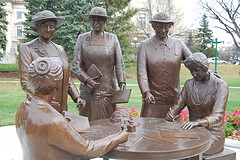
The Famous Five
Famous Five Monument – Manitoba Legislative Building. Photo by AdolfGalland

October 18th is the anniversary of the Persons Case, when five Alberta women won their fight to have women declared “persons” under the law. The battle stemmed from an 1867 common law ruling that “Women are persons in matters of pains and penalties, but are not persons in matters of rights and privileges.”
With her sights set on a Senate seat, Emily Murphy joined forces with four other like-minded women, Irene Parlby, Nellie McClung, Louise McKinney and Henrietta Muir Edwards, to appeal to the Supreme Court of Canada for clarification of the definition of the word ‘person’ as it appeared in the British North America Act.
Sections 23 and 24 of the British North America Act (now referred to as the Constitution Act, 1867) defined the qualifications for the Senate. The British North America Act used the words ‘he’ and ‘him’ when referring to individuals and ‘persons’ when referring to more than one individual.  The Supreme Court of Canada took the position that in 1867, the year the  British North America Act came into force, the use of the words ‘he’, ‘him’ and ‘persons’ would have been interpreted as referring only to men thus ruling women ineligible as persons qualified for appointment to the Senate and other matters of politics and affairs of state (See Edwards v. Canada (Attorney General) [1928] S.C.R. 276.).
The women, by then known as the “Famous Five”, appealed to what was then the highest Court in Canada, the Judicial Committee of the Privy Council. On October 18, 1929 Lord Sankey delivered the Council’s decision in favour of the women. In his announcement, the Lord Chancellor stated that the British North America Act planted in Canada was “a living tree capable of growth and expansion within its natural limits” (See Edwards v. A.G. of Canada [1930] A.C. 124.).  He also noted: “that the exclusion of women from all public offices is a relic of days more barbarous than ours. And to those who would ask why the word “person” should include females, the obvious answer is, why should it not?” As a result, the Council concluded that, “the word ‘persons’ in Sec. 24 includes members both of the male and female sex… and that women are eligible to be summoned to and become members of the Senate of Canada.”
The Persons Case represented a significant step forward for women’s rights in Canada. On February 14, 1930, Mrs. Cairine MacKay Wilson became Canada’s first woman Senator.  Today, there are 37 women in the Senate, representing approximately one-third of the current 105 seats.
Since 1979, outstanding individuals who have helped to advance equality for women in Canada have been recognized by means of the Governor General’s Awards in Commemoration of the Persons Case. This year six individuals have been named as recipients of this Award. The Right Honourable David Johnston, Governor General of Canada will present the Awards during a ceremony at Rideau Hall on Persons Day, October 18, 2011.
For more information on the Persons Case and its historical significance:
Herstory: An Exhibition. (1998). Law: The “Persons” Case: http://library.usask.ca/herstory/person.html
Hughes, V. (2001/2). How the Famous Five in Canada Won Personhood for Women . London Journal of Canadian Studies, 17: http://www.canadian-studies.net/lccs/LJCS/Vol_17/index.html
Library and Archives Canada. (2008). Famous Five: http://epe.lac-bac.gc.ca/100/206/301/lac-bac/famous_five-ef/www.lac-bac.gc.ca/famous5/index-e.html
Section15.ca. (2004). Persons Case: http://section15.ca/features/ideas/2004/12/22/persons_case/

(Photo: http://www.flickr.com/photos/35477558@N04/5069199377/)


Filed Under: Blogosaurus Lex Tagged With: constitutional law, Edwards v. Canada, Famous Five, human rights, legal history, legal reform, Supreme Court of Canada, women

Contempt of Parliament? What does that even mean?

April 13, 2011 By Carole (Staff Lawyer)

In the past few weeks, we have heard a great deal about “contempt of Parliament”.  This is because, for the first time in Canadian history, and apparently in Commonwealth history, an entire government has been found to be in contempt of Parliament. Naturally, the question that arises is: what does that actually mean?  Many Canadians had not ever heard the term before. As is often the case with matters of the legal sort, the answer is a bit long and we have to step back a bit to look at the greater context. Shall we?
In a parliamentary system (which Canada has), members (“Members”) of the House of Commons, the Senate and provincial/territorial legislative assemblies (the “House”) have something called “parliamentary privilege” . This concept was handed down to us from the British system (sometimes called the Westminster system) that we inherited under the Constitution Act 1867 (formerly known as the British North America Act). In fact, it is right there in the Constitution Act 1867 (“CA 1867”) – section 18, to be precise.
In a nutshell, parliamentary privilege (also sometimes called “absolute privilege”) is a kind of immunity which grants Members protection against civil or criminal liability for actions done or statements made related to one’s duties as a legislator. The Supreme Court of Canada once described it like this:

“Privilege” […is] the legal exemption from some duty, burden, attendance or liability to which others are subject. It has long been accepted that in order to perform their functions, legislative bodies require certain privileges relating to the conduct of their business. It has also long been accepted that these privileges must be held absolutely and constitutionally if they are to be effective; the legislative branch of our government must enjoy a certain autonomy which even the Crown and the courts cannot touch.

In other words:  in order to do their jobs, they need a little leeway.
Then, there are two basic kinds of privilege:  individual privilege and collective parliamentary privilege. Individual parliamentary privileges include: freedom of speech; freedom from arrest in civil action; exemption from jury duty; the exemption from appearing as a witness;  the freedom from obstruction, interference, intimidation and molestation. Collective parliamentary privileges include: the power to discipline; the regulation of the House’s internal affairs; management of employees; authority to maintain the attendance and service of Members; the right to institute inquiries and to call witnesses and demand papers; the right to administer oaths to witnesses; and the right to publish papers containing defamatory material.
Ever wondered why politicians can say such nasty things inside the House: things they would never say outside the House? Now you know.
So what exactly does this have to do with contempt I hear you ask? Well, one of the most important rules about when parliamentary privilege applies is that no privilege can exceed the powers, privileges and immunities of the imperial Parliament as it stood in 1867, when the first Constitution was written (that what it says in section 18 of CA 1867). So…. there are limits (and we have known what those limits are for quite some time).  A member cannot push it too far. Result: if s/he does push it too far, there are consequences.  For example, if a Member violates a privilege, s/he can be in “breach of privilege” and s/he can be disciplined by the House. In addition…here it comes… if a Member goes beyond the limits of privilege, s/he can be determined to be in “contempt”, and disciplined by the House.  Also, if the government as a whole goes beyond the limits of privilege, it can be determined to be in “contempt”, and disciplined by the House.
In other words: a little leeway, yes;  too much leeway, no. The reasoning: too much privilege would actually get in the way of the House doing its job. So:  you guessed it, it is the oh-so-Canadian question of “balance”, yet again.
In some Commonwealth countries, this “contempt” is included in criminal law. In Canada, the issues stay within the House. Specifically, the rules about it can be found in the House of Commons Procedures and Practice Manual (the “Manual”) and similar documents relating to the Senate and provincial/territorial legislatures. Here is an excerpt from the House of Commons Manual:

Any disregard of or attack on the rights, powers and immunities of the House and its Members, either by an outside person or body, or by a Member of the House, is referred to as a “breach of privilege” and is punishable by the House.  There are, however, other affronts against the dignity and authority of Parliament which may not fall within one of the specifically defined privileges. Thus, the House also claims the right to punish, as a contempt, any action which, though not a breach of a specific privilege, tends to obstruct or impede the House in the performance of its functions; obstructs or impedes any Member or Officer of the House in the discharge of their duties; or is an offence against the authority or dignity of the House, such as disobedience of its legitimate commands or libels upon itself, its Members, or its Officers.  […] The rationale of the power to punish contempts, whether contempt of court or contempt of the Houses, is that the courts and the two Houses should be able to protect themselves from acts which directly or indirectly impede them in the performance of their functions.

The result: there is no specific list of things that amount to contempt. We just know that if a Member/government goes beyond privilege, they might be found in contempt. This is how a lot of the law works, really:  you have to have a little direction, but you don’t want to tie your hands too much, as you want to be able to examine each case on its facts, and you want to leave yourself some flexibility to deal with new types of things you could not have anticipated in advance (in 1867 – who knew about Twitter?).
That said, actions which can amount to a contempt of Parliament vary, but typically include such things as: deliberately misleading (i.e.: lying to) the House or a parliamentary committee; refusing to testify  before, or to produce documents to, a House or committee; and attempting to influence a member, for example, by bribery or threats. The penalties for contempt of Parliament can include jail time, and, in the case of a minority Parliament, usually result in a vote of non-confidence.
OK…so given how much politicians are known to “spin” things, this contempt sanction should come up all the time, right? Wrong.
The use of the contempt is actually quite rare (if you are interested, the footnotes in the Manual contain the short list).  Think about it: nothing would get done if this were used all the time. There is, in essence, an acceptance by all sides that this is not be used as a knee-jerk reaction or a partisan tactic: it is to be used only in the most serious of circumstances.  This has to do with the very core of democracy, and it is not to be used lightly. As noted in the Manual:

The reluctance to invoke the House’s authority to reprimand, admonish or imprison anyone found to have trampled its dignity or authority and that of its Members appears to have become a near constant feature of the Canadian approach to privilege.

Even the procedures around how this finding gets made ensure that a concern about possible contempt is treated with the utmost care. Specifically, it has been the practice of the House in such instances to refer the matter to committee for investigation to determine if a contempt has been committed and therefore not prejudge the findings of the committee.
That is what occurred in this case. It started with a request from the House finance committee asking to see detailed cost breakdowns for jets, and the impact of corporate tax cuts and crime bills on the federal treasury.
Initially, the government said it could not release these details because they were protected by cabinet confidence, a principle that allows information to be kept secret and exempts it from access-to-information laws. The Opposition argued that once a government announces its intentions publicly, the information is no longer protected by cabinet confidence. On March, 9, 2011, the Speaker issued a report declaring two possible charges of contempt of Parliament. The first was against the Minister responsible for the Canadian International Aid Agency. It alleged that the Minister added the word “not” to a funding memo for an aid agency, resulting in the request being denied and lied about in testimony before a committee. The Speaker also ruled that Cabinet itself could also be in contempt of Parliament for not disclosing the cost of its crime policies and new fighter jets. He sent this report to a committee, which, on March 21, 2011, ruled that the government was in contempt of Parliament.  More specifically, it found that the government’s failure to produce all documents that had been requested from it or to provide a satisfactory explanation for withholding them impedes the ability of Members of Parliament (MPs) to carry out their duties, thereby resulting in contempt. On March 25, 2011 the finding of contempt then led to a vote on a motion of non-confidence, which resulted in the conclusion of the 45th session of Parliament, and caused the government the first to fall on a charge of contempt.
So why does this matter?  Either way you cut it, this was an historic vote. Only five other non-confidence votes have happened in Canada’s history, according to information on the Library of Parliament website. This is the first time it has occurred because a majority of MPs voted that they believed the government was in contempt of Parliament. It is a rather large moment in Canadian history and it is our obligation as citizens and voters to understand it.
Respecting Parliament is key to making Parliament work.  As voters, the question for each of us is: in that eternal Canadian question of balance, where is the line? At what point does “spin” become disrespect? The answer may be different for each of us. The point is, we need to think about it and decide. That is the beauty of our democracy!
For more information:
http://laws-lois.justice.gc.ca/eng/const/page-2.html
http://www.cbc.ca/news/politics/story/2011/03/25/pol-defeat.html
http://www2.parl.gc.ca/marleaumontpetit/DocumentViewer.aspx?Sec=Ch03&Seq=4&Lang=E

Filed Under: Blogosaurus Lex Tagged With: contempt, Government of Canada, parliament

  • « Previous Page
  • 1
  • 2
  • 3
  • Next Page »

What’s New

Get up-to-date on the latest news and upcoming events at CPLEA

Sign up for our monthly newsletter!

Order Free Print Copies

Every year we send out thousands of free printed resources about the law in Alberta.

Just ask, and we'll do the printing for you!

Order Free Print Copies of our Legal Resources

Territory Acknowledgement

The Centre for Public Legal Education respectfully acknowledges that we are located across Treaty 4, 6, 7, 8 and 10 territories, and respects the histories, languages, and cultures of First Nations, Métis, Inuit, and all First Peoples of Canada, whose presence continues to enrich our vibrant community.

Funders & Partners

alf-logo_tn
sof-logo_tn
sof-logo_tn
Terms of Use